What Is a Digital Flatbed Cutter?
A digital flatbed cutter is a computer-controlled finishing machine that processes sheet or board material on a flat work surface. Instead of using a shape-specific physical die, it follows a programmed vector path and uses the installed tool to perform operations such as contour cutting, kiss cutting, through cutting, creasing, perforation or drawing. The available operations depend on the machine, tool configuration and material.
A flatbed cutter is not the same as a flatbed printer. A printer applies ink to a substrate, while a cutter converts a digital cut file into a finished shape. For pre-printed work, a supported camera or optical registration system can read registration marks and align the cut path with the printed graphics.
How Does Digital Flatbed Cutting Work?
1.Prepare the artwork and cut path. The production file separates printed artwork from vector lines for cutting, creasing or perforation.
2.Load and secure the material. A sheet is placed on a static table, or flexible media is advanced on a roll-feeding or conveyor configuration. The hold-down method must keep the substrate stable during processing.
3.Register printed graphics when required. On supported equipment, a camera or sensor locates registration marks and adjusts the cut path to the printed image.
4.Match the tool and settings to the substrate. Blade or wheel type, pressure, speed and number of passes depend on the material and the required result.
5.Run and inspect a sample. Check edge quality, crease position, liner protection and print-to-cut alignment before releasing the full job.
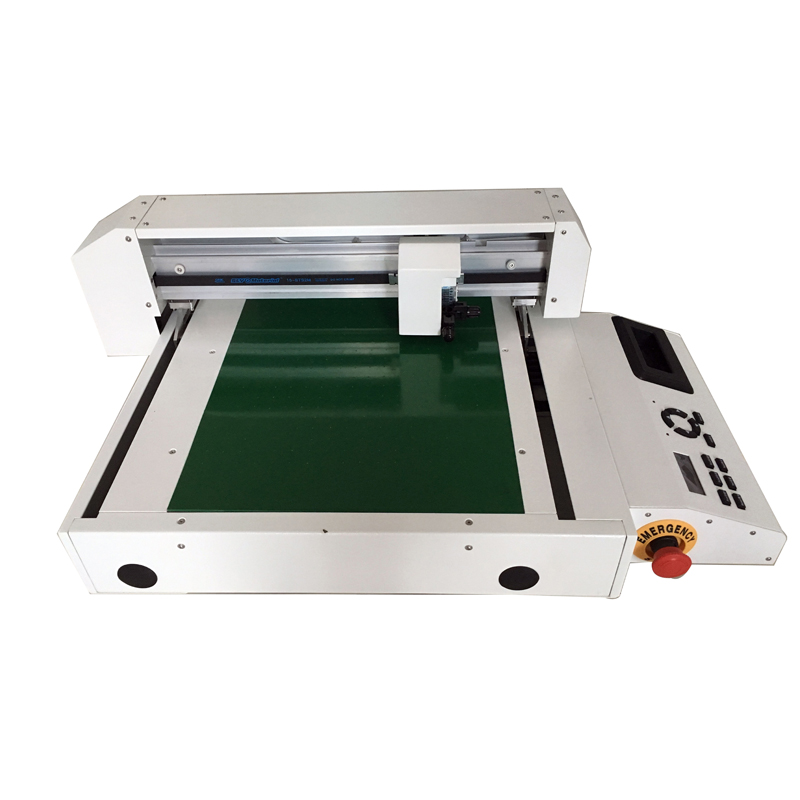
Digital Flatbed Cutter Applications by Workflow
Packaging Samples and Short-Run Cartons
Digital flatbed cutting is used to make folding-carton samples, custom inserts, sleeves and short-run packaging without ordering a new physical die for every design. A typical workflow combines through cutting for the outer shape with creasing for fold lines. This is useful for prototyping, version changes and on-demand packaging where designs change frequently.
Labels, Stickers, Tags and Printed Graphics
For printed sheets, a supported registration system can align contour paths with graphics. Kiss cutting separates the label face while retaining the liner; through cutting separates the finished piece; perforation creates controlled tear lines. Common outputs include adhesive labels, stickers, swing tags, cards and custom-shaped printed samples.
Commercial Print and Prototyping
Print shops and design studios use flatbed digital cutters for mock-ups, presentation samples, cards, paper engineering and low-volume custom work. The digital workflow allows the operator to revise a vector path instead of manufacturing a new die, which is useful when dimensions or artwork versions are still changing.
Signs, Displays and Promotional Graphics
The wider digital flatbed cutter market also serves point-of-sale displays, indoor signs, decals and shaped display graphics. These jobs can include films, paper-based display board, foam board or other substrates. However, rigid or thick boards may require an oscillating tool, V-cut tool or router that is not available on every machine. Confirm the exact model and test the actual substrate before production.
Patterns, Stencils and Transfer Graphics
Pattern paper, masking film, heat-transfer graphics and selected stencil materials can be cut from digital files. Here, material stretch, surface friction, backing construction and hold-down stability are as important as the nominal material name.
What Materials Can a Digital Flatbed Cutter Process?
| Material group | Common examples | Typical operation | What to verify before cutting |
|---|
| Paper and paperboard | Paper, cardstock, cardboard, folding carton and selected corrugated board | Through cut, crease, perforation, drawing | Sheet weight or caliper, coating, flute direction, fold quality and hold-down |
| Labels and adhesive media | Self-adhesive labels, sticker stock and backed vinyl | Contour cut, kiss cut, through cut, perforation | Face stock, liner, adhesive, laminate, static, curl and print registration |
| Films and synthetic sheets | Synthetic paper and selected PP, PET or PVC films | Contour cut, kiss cut or through cut | Film thickness, stretch, surface slip, backing and whether the material is supplied in sheets or rolls |
| Display and packaging boards | Display board, foam board and other lightweight board materials | Through cut, crease or V-cut when supported | Density, thickness, internal structure, tool availability and required edge finish |
| Rubber and stencil media | Selected masking film, sandblast stencil and rubber-based media | Contour cut or through cut | Hardness, thickness, blade geometry, number of passes and sample edge quality |
| Pattern and textile-related media | Pattern paper and selected fabric or leather | Pattern cutting, marking or drawing when supported | Stretch, fraying, surface condition, hold-down and appropriate tool |
Material trade names alone are not enough to approve a job. Two products sold under the same generic name can differ in density, coating, liner, adhesive or internal structure. For a meaningful cutting test, provide the substrate name, thickness or weight, sheet or roll format, printed or laminated condition, required cut type and finished size.
Digital Flatbed Cutter vs Other Equipment
| Equipment | Main function | Media handling | Typical reason to choose it |
|---|
| Digital flatbed cutter | Cuts, creases, perforates or draws from a digital path, depending on tools | Static table or conveyor | Custom shapes, printed contour work, samples and changing designs |
| Roll-fed cutting plotter | Cuts compatible flexible roll media | Friction or roll feed | Long flexible media and continuous roll workflows |
| Flatbed printer | Prints graphics or ink onto a flat substrate | Flat printing bed | Image production rather than finishing cuts |
| Conventional die cutter | Uses a physical die to repeat a fixed shape | Sheet or web, depending on press | Stable repeat jobs where die setup is justified |
How to Specify a Digital Flatbed Cutter
Before requesting a quotation or sample test, document:
whether the material arrives as individual sheets, boards or rolls;
the exact material name, thickness or weight, coating and backing;
maximum sheet or finished-part dimensions;
whether the work is printed, laminated or unprinted;
required operations: kiss cut, through cut, crease, perforation, marking or drawing;
whether registration marks must be detected;
typical batch size, design-change frequency and daily job mix;
the required edge, fold and liner quality.
These details help separate a static sheet-finishing requirement from a roll-feeding application and prevent a model recommendation based only on a broad material name.
Conclusion
Digital flatbed cutter is ideal for tasks that require high precision and machining for medium weight materials. At the same time, the flatbed cutter is also suitable for presenting your complex and exquisite designs on media such as sticky notes, mask films, foam boards, cardboard, oily boards and sandblasted rubber. Some flatbed cutters have the ability to simultaneously load knives and a drawing pen. Therefore, the sample/shoe designer can draw the mark on the medium and then cut it, and the user does not need to manually replace the corresponding pen and knife.
In addition, some flatbed cutters have a standard positioning marker detection sensor that makes it easy to recalibrate the position of the die-cut media that has already been printed.
Compared to friction-driven drum type cutting plotters, flat-plate cutters can use more materials, so the scope of application is broader, such as shop door, fluorescent signs, body advertising, awnings, making personalized T-shirts. Thermal transfer patterns, packaging design, garment proofing, masking film, sandblasted rubber stencils, etc.
We are China Cutting Plotter Manufacturer. If you have any questions, please contact us. We are experts in it.
FAQ
Q1:What are some applications of cutting machines?
Cutting machines are used for packaging samples, labels, stickers, tags, cards, signs, displays, stencils and pattern work. Depending on the configuration, they can cut, crease, perforate or draw.
Q2:What is the best plotter cutter?
There is no single best plotter cutter. Choose according to the material format, working size, required cut type, registration needs and actual production volume.
Q3:What are the two types of cutting machines?
In digital print finishing, two common types are flatbed cutting machines for sheets or boards and roll-fed cutting machines for compatible flexible roll media.
Q4:What are the main uses of a cutter plotter?
A cutter plotter follows vector paths to produce lettering, decals, labels, stickers, signs, transfer graphics and paper or card samples. Its exact uses depend on the media and machine configuration.
 vicutcnc@cncvicut.com