Key Takeaways
Digital die cutting follows a cut file and needs no shape-specific physical die, so it is usually the first method to evaluate for short runs, frequent artwork changes and many SKUs.
Traditional rotary or flatbed die cutting uses physical tooling. Its setup and tooling must be justified, but it can be the stronger production method for stable, repeat high-volume jobs.
There is no universal break-even quantity. Compare the complete job: tooling, setup, test waste, cutting time, matrix removal, slitting, rewinding and future reorders.
Label material and liner behavior can change the result. A production sample is more useful than a headline speed.
Many converters use both methods: digital for volatile work and conventional tooling for repeat volume.
Digital die cutting is usually better for short, variable label work because a new vector path can replace a physical die. Traditional die cutting is usually better for long, repeat runs once the correct die is mounted and the process is stable. The right choice depends on SKU count, reorder pattern, contour length, material construction and the required finished roll—not volume alone. Start with the VICUT digital label finishing solution when the comparison involves printing, cutting and finished-roll output as one workflow.
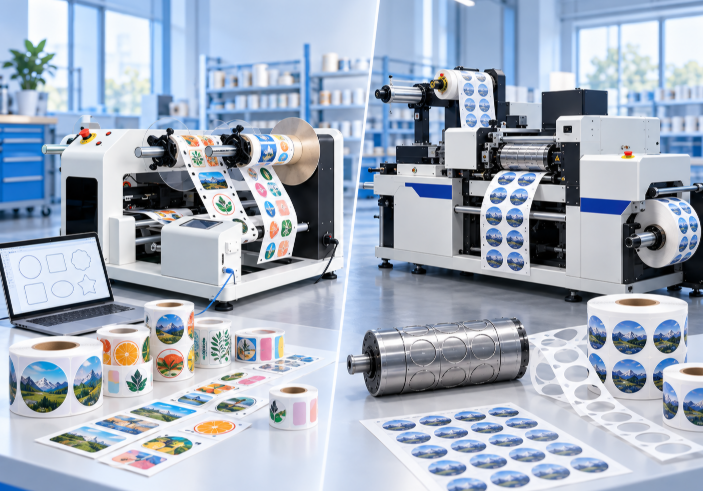
Digital vs Traditional Label Die Cutting at a Glance
| Decision factor | Digital cutting | Traditional die cutting |
|---|
| Cutting method | Blade follows digital path | Shaped physical die cuts each repeat |
| New shape | Load and verify a new file | Manufacture, receive and mount new tooling |
| Best starting point | Short runs, samples, variable SKUs | Stable artwork, repeat high-volume production |
| Changeover | File, material and setting change | Die change plus impression and registration setup |
| Production motion | Tool traces the contour | Die cuts the complete repeat as the web or sheet moves |
| Cost question | Machine time per contour | Tooling and setup spread across the run |
| Main risk | Long or complex paths reduce throughput | Wrong or worn tooling creates waste and delay |
How the Two Methods Work
In a digital label workflow, the operator prepares a cut path, loads the printed or blank roll, establishes registration where required, and sets the blade and material parameters. The cutter follows every contour. Shape changes are file changes, but the operator still has to prove registration, cut depth, matrix stripping and output handling.
Traditional label die cutting uses a solid or flexible die working against an anvil or press surface. Rotary systems process a web continuously; flatbed presses use a repeated pressing motion. The die can cut every label in a repeat at once, which is why conventional equipment remains relevant for established high-volume work.
For the component-level explanation, see how a rotary die cutting machine works. Cut depth is a separate decision; VICUT's guide to kiss cutting versus full cutting explains how the liner changes the required result. The current VICUT roll label die cutting machine range should be read at model level because finishing stations and output functions are not automatically shared across the range.
The distinction matters because the phrase “digital die cutting” is industry shorthand: a knife-based digital cutter is actually dieless. The PRINTING United Alliance comparison paper makes the same terminology point and explains the core trade-off: conventional tooling is fast after the die is made, while digital files make size and design changes easier.
Which Method Fits Short Runs and Many SKUs?
Start with digital cutting when order quantities are low or unpredictable, buyers request proofs, and artwork changes often. A file-driven workflow avoids maintaining a separate die for each contour. It also reduces the commercial friction of quoting a new shape before the customer has committed to repeat volume.
Do not treat “no die” as “no setup.” A short label run still needs preflight, correct marks, web tension, blade calibration, a test cut and matrix-removal approval. Complex outlines have more cutting distance than simple circles or rectangles, so two jobs with the same label count may not take the same time. If the required output includes sheets rather than rewound rolls, compare the roll-to-roll and roll-to-sheet workflow before selecting the finishing configuration.
VICUT’s roll label die cutting machine range is designed around digital, short- to medium-run label finishing. Available configurations vary, so buyers should confirm whether the quoted model includes the required lamination, matrix removal, slitting, rewinding or roll-to-sheet output.
When Does Traditional Die Cutting Make More Sense?
Traditional rotary die cutting becomes easier to justify when the design is frozen, the same construction is reordered, and the run is long enough to spread tooling and setup across many labels. The physical die cuts a full repeat rather than tracing every contour. That production logic can outperform a digital knife on a stable, high-volume job.
But “high volume” is not a fixed number. A converter should calculate its own crossover because die price, machine rate, number of cavities, contour complexity, material, waste, labor and reorder frequency differ. A cheap die does not rescue an unstable liner; a fast press does not remove the cost of repeated artwork changes.
A Practical Break-Even Worksheet
Use the same production specification for both quotations:
| Input | What to record |
|---|
| Job mix | Annual quantity, order frequency and number of SKUs |
| Artwork | Number of unique contours and expected revisions |
| Material | Facestock, adhesive, liner, coating and roll width |
| Setup | Prepress, tooling, mounting, calibration and test waste |
| Run | Cutting time, operator attention and stoppages |
| Finishing | Lamination, matrix stripping, slitting, rewinding or sheeting |
| Quality | Registration, peel behavior, liner condition and edge quality |
For conventional work, add die manufacture, delivery, storage, maintenance and replacement. For digital work, add file preparation and estimated contour time. Then compare the cost and lead time of the complete approved roll, not only the cutting station.
Material and Liner Quality Can Override the Cost Model
Kiss cutting must separate the facestock and adhesive while preserving the release liner. That makes material construction part of the machine decision. Avery Dennison’s technical bulletin for thin film liners recommends checking die-cut quality across the web and warns against excessive pressure that deforms the liner. Its numeric settings apply to the specified Avery construction, not to every label stock, but the quality-control principle is universal: approve the real laminate and inspect more than one point in the roll. If laminate is part of the job, also review when labels should be laminated before cutting before finalizing the sequence.
Run a Controlled Production Trial
Give each supplier the same files and material. Include a simple contour, a detailed contour, the smallest regular label and the most difficult liner used in production. Record setup time, usable output, matrix breaks, registration drift, rejected labels, changeover time and operator intervention. Repeat one prior job to test saved settings or tooling repeatability. The digital label cutter testing guide provides a practical structure for comparing the same files and materials across suppliers.
Ask for the cutting mechanism in writing. Product names are not standardised across suppliers, so the written quotation — not the model name — should be your reference. Within the VICUT range, every roll label
model finishes with blades on servo-driven cutting heads and requires no physical die, including the models whose names retain the historical "rotary" or "die cutting" wording; laser is a separate technology and is
not offered in this range. A quotation should still state which mechanism the machine actually uses: a cylindrical die, a flexible die, drag knives, oscillating tools or a laser.
The quotation should state whether the machine uses a cylindrical die, a flexible die, drag knives, oscillating tools or a laser. For output-stage questions, confirm whether slitting and rewinding are included, optional or handled on separate equipment.
Which Label Die Cutting Method Should You Choose?
Choose digital first when the business case depends on quick changeovers, many shapes, short runs or test orders. Choose conventional tooling first when the business case depends on repeating one approved label at sustained volume. Consider a hybrid production policy if both job types are important.
VICUT can review a requirement sheet against its digital roll label finishing systems. Send actual PDFs, material constructions, roll dimensions and the required output format when requesting a recommendation; that produces a more defensible answer than asking for the “best” cutter in isolation. For a fair capacity comparison, record accepted output using the real digital label finishing throughput method, not only the machine’s headline cutting speed.
Frequently Asked Questions
Is digital die cutting always cheaper?
No. It avoids shape-specific tooling, but machine time rises with total contour length and job complexity. Traditional tooling can be more economical for long, stable repeat runs.
Does digital die cutting mean laser cutting?
Not necessarily. Digital cutting can use blades or lasers. Confirm the cutting technology, compatible materials and ventilation or consumable requirements for the quoted machine.
Can one label converter need both methods?
Yes. Digital and conventional equipment solve different order patterns. Many operations route prototypes and volatile SKUs to digital finishing and stable repeat volume to physical dies.
What should be included in a label cutting test?
Use production artwork and material, then inspect registration, cut depth, liner condition, matrix stripping, edge quality, output format and changeover recovery.
Choose the Right Cutting Route With a Real Job
If you are deciding between digital and conventional die cutting, send VICUT a representative artwork file, label construction, normal run length, reorder pattern and required finished format. The VICUT team can use those inputs to identify which roll label cutting configuration merits a sample test. Contact VICUT to compare the two routes against your production mix rather than a generic volume rule.
 vicutcnc@cncvicut.com