Key takeaways:
Kiss cutting and die cutting both use the same core process — a blade or rotary die tracing a digital contour through material — but they differ in cut depth.
Kiss cutting cuts only through the top face material, leaving the backing liner intact underneath, which is what makes peel-and-stick labels and multi-piece sticker sheets possible.
Die cutting (also called through cutting) slices completely through every layer, including the backing, producing a fully separated individual piece.
If your product needs to peel cleanly off a liner — most pressure-sensitive labels, application decals, and roll-fed stickers — kiss cutting is the right method.
If your product needs to come out as a standalone shape with no backing attached — packaging inserts, tags, gaskets, or single stickers sold individually — full die cutting is the right method.
Most commercial roll label die cutting machines can switch between both modes on the same equipment, so the choice usually comes down to your product spec rather than needing two separate machines.
What Is Kiss Cutting?
Kiss cutting is a controlled-depth cutting technique in which the blade — whether a rotary die or a digital drag-knife — cuts through the label face stock and adhesive layer while stopping just short of the backing liner. The name comes from the way the blade barely "kisses" the liner rather than slicing through it. This shallow, precise depth control is what allows finished labels to stay attached to their backing sheet for storage, shipping, and application, while still peeling away cleanly one at a time when needed.
Kiss cutting is the standard technique behind most pressure-sensitive product labels, roll-fed stickers, and multi-label sheets, because it keeps individual pieces organized on a continuous liner instead of producing loose, separated shapes that would be harder to handle at scale.
What Is Die Cutting (Through Cutting)?
Die cutting, in its full-depth form, cuts completely through every layer of material — face stock, adhesive, and backing liner — producing an individual piece with no surrounding material left behind. This is sometimes called "through cutting" specifically to distinguish it from kiss cutting, since both are technically types of die cutting but produce very different results.
Die cutting is the right choice when a product needs to exist as a standalone shape: individual stickers sold one at a time, packaging inserts, box blanks, gaskets, or any application where a backing sheet isn't part of the final product. For a deeper technical breakdown of how the die cutting process itself works — including rotary and semi-rotary tooling — see our guide on what die cutting means in label printing.
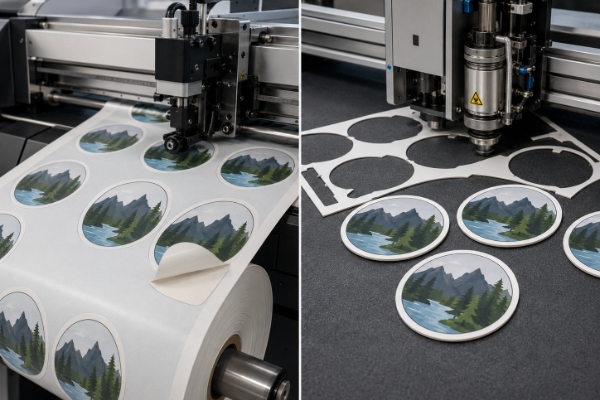
Kiss Cutting vs Die Cutting: Key Differences
| Comparison Factor | Kiss Cutting | Die Cutting (Through Cutting) |
|---|
| Cut depth | Through face stock only | Through all material layers |
| Backing liner | Stays intact | Fully cut through, no liner remains |
| Typical output | Labels/stickers on a continuous sheet or roll | Individual, fully separated pieces |
| Best for | Peel-and-stick labels, sticker sheets, decals | Standalone stickers, tags, packaging inserts, gaskets |
| Handling | Easier bulk shipping and application | Requires individual piece handling |
| Blade pressure control | Requires precise, shallow depth calibration | Full-force, single-pass cut |
| Common products | Product labels, cosmetic labels, beverage labels | Die-cut stickers, box blanks, foam gaskets |
Advantages and Disadvantages of Kiss Cutting vs Die Cutting
The main difference between kiss cutting and die cutting is how deeply the material is cut and how the finished product is supplied. Kiss cutting cuts through the face material and adhesive while leaving the backing liner intact, while die cutting cuts completely through the material to create a separate piece.
Advantages of Kiss Cutting
Kiss cutting is widely used for adhesive labels, sticker sheets, roll labels, and vinyl decals. Its main advantages include:
Easy peeling: Labels and stickers remain attached to the backing liner and can be peeled off individually.
Efficient handling: Products can remain organized on sheets or rolls during storage, transportation, and application.
Suitable for roll-fed production: Kiss cutting works well for continuous roll labels and other pressure-sensitive materials.
Flexible for short runs: Different shapes and designs can be processed without changing the overall material format.
Disadvantages of Kiss Cutting
Requires precise cutting depth: Incorrect blade pressure may cut through the liner or leave the label partially uncut.
Usually requires a backing liner: Kiss cutting is mainly used for layered adhesive materials.
Not suitable for standalone products: If the finished shape needs to be completely separated, die cutting is generally more appropriate.
Advantages of Die Cutting
Die cutting is suitable when the finished product needs to be completely separated from the surrounding material. Common advantages include:
Fully separated products: The finished shape can be removed directly from the sheet or material.
Suitable for complex shapes: Custom contours can be produced for stickers, tags, packaging components, and other products.
Wide material compatibility: Die cutting can be used for materials that do not require a backing liner.
Suitable for industrial parts: Foam pads, gaskets, and other shaped components can be produced through full-depth cutting.
Disadvantages of Die Cutting
More handling: Fully separated pieces can be harder to organize and package than products kept on a liner.
Potential material waste: The amount of waste depends on product shape and material nesting.
Tooling requirements: Traditional die cutting may require a physical die when the design changes.
Kiss Cutting vs Die Cutting Applications
Understanding the applications of kiss cutting and die cutting makes it easier to select the right cutting method for a specific product.
| Application | Recommended Method | Why |
|---|
| Roll labels | Kiss cutting | Labels remain attached to the backing liner |
| Product labels | Kiss cutting | Easy peeling and application |
| Sticker sheets | Kiss cutting | Individual stickers can be peeled from the sheet |
| Vinyl decals | Kiss cutting | Keeps adhesive graphics on the liner |
| Individual stickers | Die cutting | Produces completely separated pieces |
| Packaging inserts | Die cutting | Creates standalone shapes |
| Product tags | Die cutting | Fully separates the finished tag |
| Foam parts and gaskets | Die cutting | Requires full-depth cutting |
Which Cutting Method Fits Your Product?
The right method depends on how the finished piece needs to behave once it leaves the machine, not on which technique sounds more advanced:
Peel-and-stick product labels (beverage, cosmetic, chemical, logistics labels) almost always require kiss cutting, since the label needs to stay on its liner until the exact moment of application.
Sticker sheets with multiple designs sold as one unit typically use kiss cutting so the full sheet stays intact while individual stickers can still be peeled off one at a time.
Single stickers, decals, or packaging inserts sold as standalone pieces are usually die cut all the way through, since there's no liner to preserve.
Gaskets, foam pads, and non-adhesive shapes are die cut by necessity, since there's no backing layer involved in the first place.
Short-run or sample production with mixed order types benefits from a machine that can switch between kiss cutting and full die cutting without a hardware change, which is where digital roll die cutters have an advantage over dies built for one depth only.
Distributors quoting equipment for label converters should confirm which cut type dominates the client's order mix before recommending a machine, since blade depth control accuracy is a bigger differentiator for kiss-cutting-heavy production than raw cutting speed.
Can a Single Machine Do Both Kiss Cutting and Die Cutting?
Yes — most modern digital die cutting equipment is not locked into one cut depth. A few points worth knowing before buying:
Digital rotary die cutters with adjustable blade pressure can switch between kiss cutting and full through cutting simply by changing the depth setting in software, without swapping physical tooling.
Combined roll-and-flatbed digital cutters extend this flexibility further, handling both roll-fed kiss-cut labels and flatbed die-cut sheet materials on one machine.
Consistency matters more than raw force for kiss cutting: look for blade compensation and pressure calibration features rather than just top cutting speed, since a small depth error is the difference between a clean kiss cut and a liner that's accidentally cut through.
For shops running mixed jobs — some full-sheet decals, some peel-and-stick labels — a single flexible machine is usually more cost-effective than buying separate kiss-cut and die-cut equipment.
Conclusion
Choosing between kiss cutting and die cutting comes down to one question: does the finished piece need to stay on a backing liner, or come out fully separated? Peel-and-stick labels, application decals, and multi-label sheets call for kiss cutting, while standalone stickers, packaging inserts, and gaskets call for full die cutting. Since most digital roll die cutting equipment can switch between both depths, the more useful planning question for distributors and converters is usually which cut type dominates a client's order mix, not which machine category to buy. For product specification comparisons and equipment recommendations tailored to your production needs, contact VICUT for professional support.
FAQ
Q1: Is kiss cutting a type of die cutting?
Yes. Kiss cutting and full through cutting are both variations of the die cutting process — the difference is cut depth, not the underlying technique. Kiss cutting stops at the backing liner, while through cutting slices completely through every layer.
Q2: Does kiss cutting cost more than die cutting?
Kiss cutting can take marginally longer to produce because it requires precise, shallow depth calibration rather than a single full-force pass, but the difference is usually small and depends more on order volume and material than on cutting method alone.
Q3: Can kiss-cut labels be die cut later if needed?
Generally no — kiss cutting and full die cutting are set at the time of production based on the required cutting depth. If a product needs to be fully separated from its liner, that decision should be made before the job runs, not after.
Q4: What materials work with kiss cutting?
Kiss cutting works on adhesive-backed materials with a distinct face stock and liner — paper, vinyl, PP, BOPP, PET, and similar label substrates. Materials without a liner, like foam or cardstock without backing, are die cut through rather than kiss cut.
Q5: Do I need two separate machines for kiss cutting and die cutting?
Not necessarily. Most digital roll die cutting machines with adjustable blade pressure can perform both kiss cutting and full through cutting, so a single machine often covers both needs unless order volume justifies dedicated equipment for each.
 vicutcnc@cncvicut.com