Key Takeaways
Laminate before contour cutting when the protective film must follow the finished label shape and the workflow uses continuous printed stock.
Lamination changes total thickness, stiffness, surface reflection, tension and cutting settings; test the complete construction.
Not every label needs laminate. Consider service exposure, print durability, appearance, cost and downstream recyclability requirements.
Apply and stabilize the laminate before final registration and cutting whenever the process could change web dimensions or mark readability.
Confirm the exact VICUT model’s lamination sequence and included module; inline lamination is not universal across the range.
Labels should usually be laminated before final contour cutting when a clear film is intended to protect the printed surface and end at the label’s cut edge. For the broader equipment sequence, see VICUT’s roll label die cutting machine guide. The normal roll workflow is print, laminate, register, kiss cut, remove matrix, slit and rewind. However, the correct decision depends on the label construction, print technology, exposure and whether a varnish or uncoated surface is more suitable.
When Lamination Is Worth Considering
Lamination can protect print from handling, abrasion, moisture contact and certain surface contamination, while also changing gloss, matte appearance or tactile feel. It is commonly evaluated for beverage, cosmetic, chemical, outdoor and frequently handled labels.
It should not be described as automatically waterproof or chemically resistant. A cut edge can expose paper fibers, and resistance depends on the facestock, adhesive, ink, laminate, edge and test method. Obtain the material supplier’s suitability statement and run an application-specific test.
Laminate Before or After Cutting?
| Sequence | When it fits | Main limitation |
|---|
| Print → laminate → contour cut | Continuous roll or sheet that needs edge-following protection | Cutting and registration must handle the laminate |
| Print → contour cut → laminate | Rare special workflow with later overlamination | Film may bridge gaps or trap waste areas |
| Print → varnish/coating → cut | Jobs suited to a liquid protective finish | Protection and equipment differ from film lamination |
| Print → cut with no protection | Dry, low-abrasion use or print already adequate | Lower added protection |
Applying laminate after individual labels are contour-cut is often impractical because one continuous film covers both labels and surrounding matrix. For typical pressure-sensitive converting, laminate is therefore applied to the printed web before kiss cutting and waste removal.
What Changes After Lamination?
The cutter is no longer processing the original facestock alone. It must cut through laminate, print layer, facestock and adhesive while preserving the release liner. This may require a different blade condition, exposure, force or number of passes.
Lamination can also increase stiffness and alter curl. Uneven pressure or tension can introduce wrinkles or lateral tracking changes. A glossy film may change how an optical sensor reads registration marks. These effects are why an unlaminated cutting sample does not qualify the laminated production job.
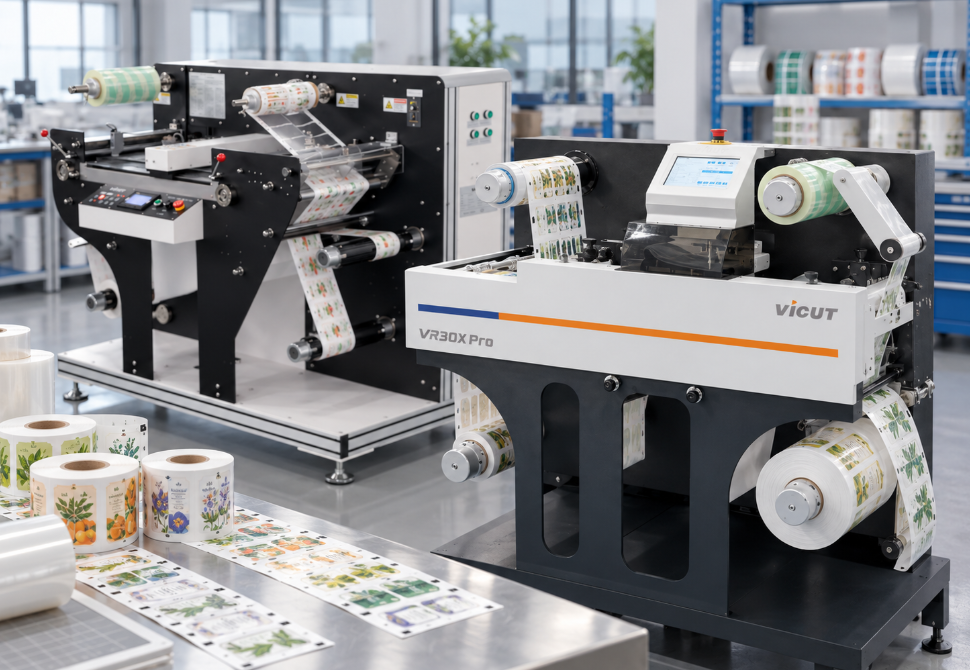
For model-level workflow planning, the VICUT VR30X Pro roll label cutter and VR320 label die cutter pages document model-specific cold-lamination and finishing functions. Their configurations are not interchangeable, so use the exact model documentation when planning a trial.
Registration Marks and Laminate Placement
Decide whether marks are covered by laminate and test that exact arrangement. If the film creates glare, the mark may read less reliably even though it remains visually clear to an operator. If the laminate is narrower than the web, its edge must not create an unstable step through the cutting or guiding area.
Run marks at the normal printer density and production speed. Inspect registration at the beginning, middle and end, including after a stop. Do not change the mark design or add improvised coverings without confirming the supported workflow.
Cold Lamination for Roll Labels
Pressure-sensitive cold laminate is commonly used with heat-sensitive printed webs because it bonds through pressure rather than a heated adhesive process. Material suitability still depends on the print surface, adhesive system, roller pressure and storage condition.
VICUT’s guide to thermal versus cold laminators explains the broad process difference. For roll labels, confirm the film type and inline module rather than assuming a general-purpose laminator matches the web and registration workflow.
How Lamination Affects Matrix Removal
The laminate becomes part of both the label and surrounding waste. It can strengthen a fragile paper matrix, but it can also make waste bridges stiffer or change the peel force. Tight corners, narrow gaps and small labels should be tested at normal run conditions.
If the matrix repeatedly breaks, inspect cut depth, geometry, laminate bond, peel angle and waste tension. Raising blade force may damage the liner without correcting an unsuitable waste pattern.
A Production Test Checklist
Identify the exact facestock, adhesive, liner, ink and laminate.
Confirm cure or stabilization requirements from the print and film suppliers.
Apply laminate with the intended overlap, pressure and tension.
Test registration-mark detection through the final surface.
Establish kiss depth and inspect the liner under controlled light.
Run the smallest and most complex regular shapes.
Test matrix removal, slitting and rewinding.
Evaluate the label on the real container and in its service environment.
Record both appearance and function. A glossy sample can look acceptable while curling, edge lift or release-liner damage makes it unsuitable for production.
Choosing a VICUT Workflow
Review the VICUT roll label cutter range and send the printed web, laminate specification, label geometry and required finished roll. Ask VICUT to demonstrate the full sequence and list every included module in the quotation.
Frequently Asked Questions
Must every product label be laminated?
No. Use laminate when the required protection or appearance justifies the added material and process. Test the unlaminated option where appropriate.
Should registration marks be under the laminate?
They may be, but readability depends on the sensor, print contrast and film surface. Follow the model’s supported layout and test it.
Can lamination fix weak ink adhesion?
It may protect the surface, but it does not correct an incompatible ink, topcoat or curing problem. Resolve print adhesion first.
Does laminate require more cutting force?
Often the construction needs a revised setting, but there is no universal increase. Establish the minimum approved setting on the actual job.
Confirm the Lamination Sequence With VICUT
Provide VICUT with the printed web, laminate product, label geometry and required service conditions. The trial should use the final construction and check film application, mark reading, kiss depth, matrix removal and roll build as one workflow. Contact VICUT to determine which roll label finishing configuration can perform the required stages and which modules must be listed separately in the quotation.
 vicutcnc@cncvicut.com