Key Takeaways
Choose an autofeed sheet label cutter when the regular job is a stack of printed sheets and the priority is repeatable feeding, print-to-cut registration and reduced manual loading.
Choose a static flatbed cutter when work is more varied, includes prototypes or larger sheets, or needs flexible placement on a vacuum table.
Both categories may support kiss cutting, full cutting, creasing and perforating, but the exact tool combination and material limits are model-specific.
Stickers, cards and packaging should be evaluated as different workflows: liner protection, sheet separation, fold quality and waste handling are not the same test.
Compare accepted output and operator handling—not only cutting speed—before choosing the machine class.
The short answer is simple: an autofeed sheet label cutter fits repeatable stacks of printed stickers and labels, while a static flatbed cutter fits mixed short-run work where manual placement and flexible media handling matter more. A shop producing cards, packaging samples and labels may need either category—or both—depending on sheet size, substrate, job variation and output expectations. The right decision is about the complete material path, not the word “flatbed” in the product name.
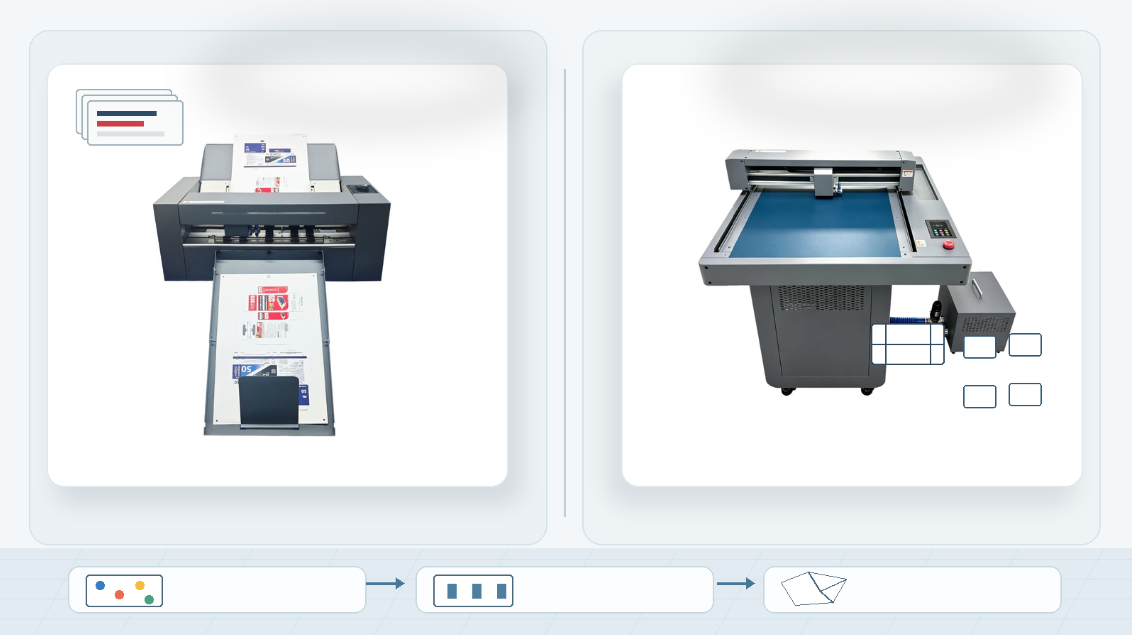
Autofeed vs Static Flatbed: Quick Comparison
| Buying question | Autofeed sheet label cutter | Static flatbed cutter |
|---|
| How does media enter? | A stack is loaded and sheets are fed automatically | Sheets or boards are placed manually on a stationary table |
| Best starting workflow | Repeated stickers, labels and tags | Samples, cards, packaging blanks and mixed flat media |
| Main productivity advantage | Less manual sheet loading and repeatable positioning | Flexible placement and easy access to unusual sheet sizes |
| Registration priority | Camera or mark reading across a sequence of printed sheets | Camera alignment on individually placed sheets or layouts |
| Tool decision | Often optimized for sheet label operations and optional creasing/perforation | Often offers a broader flatbed tool and bed-size choice |
| Main risk | Feeding curl, static, coating or mixed sheets consistently | Manual loading time, alignment variation and table-size limits |
The current search intent behind this comparison is strongly practical: buyers want to know which machine fits stickers, cards and light packaging without paying for a workflow they will not use. The VICUT autofeeding sheet label cutter range and its model pages should therefore be compared with the static flatbed cutter page at the workflow level.
1. When an Autofeed Sheet Label Cutter Is the Better Fit
An autofeed machine makes sense when the input is a regular stack of pre-printed or blank sheets and the output is a repeatable set of labels, stickers, tags or light packaging blanks. The feeding system becomes part of the production decision. Test:
sheet separation and double-feed control;
curl, static and coated media;
print-to-cut mark recognition;
top, middle and bottom sheets in a stack;
output order and collection;
recovery after a misfeed or interrupted job.
The VICUT VSC-350Pro automatic dual-head sheet cutter is documented for pre-printed or blank sheets including label sheets, sticker sheets, cardstock and thin packaging materials. Its page also separates full cutting, half cutting, creasing and perforating as different operations. That is useful evidence for a sample plan, but it should not be generalized to every sheet cutter or every material.
For a label converter or print shop with many repeated sheet jobs, automatic feeding can reduce repetitive loading and make the real changeover easier to measure. It does not remove the need to check sheet condition. A feeder that performs well on clean, flat paper may need different handling for laminated sheets, curled stock or adhesive constructions.
2. When a Static Flatbed Cutter Is the Better Fit
A static flatbed cutter is often a better starting point when the shop handles mixed prototypes, cards, packaging samples, boards or irregular layouts. The operator can position the sheet on the table, use a camera or registration marks where available, and choose a tool path for the actual job.
The VICUT FB500Pro/FB700Pro static flatbed cutter page describes full cut, kiss cut, creasing and perforation functions for model-specific flatbed workflows. It also presents the machines for packaging, swing tickets, cards and labels, with media limits stated on that page. These limits belong to the cited models; they are not a universal specification for every static flatbed cutter.
Static does not mean inaccurate. It means the material remains on a stationary table during the cut rather than passing through an automatic sheet feeder. The advantage is layout flexibility. The trade-off is that loading, alignment and collection can take more operator time when the same sheet job is repeated many times.
3. Match the Machine to the Product
Stickers and sheet labels
Prioritize kiss-cut depth, liner protection, registration and matrix or waste handling. An autofeed sheet label cutter is usually attractive when the shop receives regular stacks and wants a repeatable feeding process. A static flatbed may be better for one-off sheets, unusual sizes or difficult media that need careful placement.
Cards and tags
Cards require clean outer cuts, consistent corners and predictable sheet separation. Ask whether the cutter can handle the card stock and layout at the required size. If the sheet contains several different operations, confirm how the file assigns full-cut paths, crease lines and perforations.
Packaging samples
Packaging work adds fold quality to the test. A clean cut does not prove that a crease is usable. Check the board grain, coating, toner or ink behavior, fold direction, cracking and the removal of small waste pieces. For repeated packaging sheets, autofeed may reduce loading work; for prototypes or larger layouts, static flatbed flexibility may be more valuable.
The broader die cut sticker machine buying guide recommends starting with the input format and required output. Apply the same logic here: define whether the shop is buying a sheet-production workflow, a flexible prototype table or a combination of both.
4. Seven Factors to Compare Before Buying
Input format: regular stack, occasional sheet, oversize sheet or mixed media.
Sheet size: smallest and largest usable format, including registration margins.
Material construction: paper, synthetic sheet, adhesive label, laminate, cardstock or packaging board.
Cut operations: kiss cut, full cut, crease, perforate, mark or several in one file.
Registration: camera type, mark visibility, transparent or reflective surface behavior and repeatability.
Output handling: separated pieces, intact sheets, waste removal, collection and packing order.
Changeover: file selection, tool assignment, force calibration, loading and recovery time.
Do not compare a machine’s maximum speed as if it were accepted output. Run the complete workflow from file selection and sheet loading to approved pieces and waste collection. Record operator touches, misfeeds, registration errors, tool changes and rejected sheets.
Which One Should a Print Shop Choose?
| Production profile | First category to test |
|---|
| Hundreds of similar printed sticker sheets | Autofeed sheet label cutter |
| Mixed labels, tags and light packaging in short runs | Autofeed dual-tool model or static flatbed, tested side by side |
| One-off cards, samples and unusual sheet layouts | Static flatbed cutter |
| Packaging prototypes with frequent artwork changes | Static flatbed cutter |
| Repeated jobs plus frequent prototypes | Consider a two-machine workflow or select the category that solves the bottleneck |
If the shop is unsure, prepare one test pack containing stickers, cards and a packaging blank. Use the same files, media and pass/fail criteria with each supplier. The result should show which machine produces the most usable output with the least manual intervention—not which brochure contains the longest feature list.
Frequently Asked Questions
Is an autofeed sheet label cutter the same as a static flatbed cutter?
No. Both can use digital cutting tools, but an autofeed machine is organized around automatic sheet transport, while a static flatbed is organized around flexible placement on a stationary table.
Can either machine cut stickers and packaging?
Some models can process both, but the material, tools and settings must be verified. Sticker kiss cutting and packaging creasing are different operations and should be tested separately.
Which machine is better for cards?
Choose based on sheet volume, card stock, finished size and layout variation. Autofeed is useful for repeat stacks; static flatbed is useful for samples and unusual layouts.
What should I ask for in a quotation?
Ask for the exact model, usable sheet size, included tools, feeding method, registration system, supported materials, software workflow, accessories, training and sample-test result. The sheet sizes and materials guide can help structure the test questions.
Request a Side-by-Side Sample Test
Send VICUT the sticker sheet, card stock, packaging blank, artwork files and required output format. The team can compare an autofeed sheet label cutter with a static flatbed configuration against the same registration, cut, crease and handling criteria. Contact VICUT before approving a machine class or configuration.
 vicutcnc@cncvicut.com