Key Takeaways
Choose the machine class from the input and output: printed roll, printed sheet or unprinted stock; finished roll, sheet or individual sticker.
Confirm kiss cutting, through cutting, registration, matrix removal, slitting, rewinding and sheeting separately. A product name does not guarantee every function.
Compare usable throughput on your smallest and most complex regular jobs, not a supplier’s straight-line maximum.
Material compatibility requires both an official model limit and a successful production sample.
A written test report and configuration list are more valuable than a generic “best sticker machine” ranking.
The best die cut sticker machine is the one that converts your normal printed material into the required sellable format with stable registration and manageable changeovers. Start by deciding whether work arrives on rolls or sheets and whether finished stickers must stay on a liner. Then compare the cutting method, registration, finishing stations, software, real job speed and supplier support.
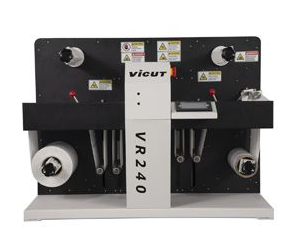
Step 1: Choose Roll-Fed, Sheet-Fed or Static Flatbed
| Your regular input and output | Machine class to evaluate first |
|---|
| Printed roll to finished label rolls | Digital roll label cutter/finisher |
| Printed roll to defined sheets | Roll cutter plus inline or separate sheeter |
| Stack of printed sticker sheets | Autofeeding sheet label cutter |
| One-off sheets, prototypes or difficult media | Suitable static flatbed cutter |
| Stable, very high-volume repeated roll labels | Conventional rotary die-cutting line may also merit comparison |
A roll-fed machine is not automatically better than a sheet-fed machine. It simply matches a different material path. Buying the wrong class can leave manual work at loading, waste removal, collection or packing.
Step 2: Define Kiss Cut and Full Cut Requirements
Most pressure-sensitive labels require a kiss cut through the facestock and adhesive while the liner remains intact. Individual stickers or the outer boundary of a sticker sheet may require full cutting through all layers.
Write the required operations on the artwork and send the same file to every supplier. If one job uses both depths, ask how the software assigns the operations and how the machine controls separated pieces. The related guide to kiss cutting and full cutting explains the production difference.
Step 3: Verify Print-to-Cut Registration
For printed stickers, the cutter must align the contour to the image. Ask which marks, sensors or cameras the quoted model uses, how it compensates for scale or skew, and what happens when a mark cannot be read. Registration should be tested on the actual printer, ink/toner, laminate, color and reflective surface used in production.
Check small circles, fine borders, long repeats and graphics near the edge. Inspect multiple positions across the roll or stack. One centered sample does not prove control over a full job.
Step 4: Map the Entire Finishing Line
The cutting station is only one part of sticker production. Build a process map:
print → optional lamination → registration → contour cut → matrix removal → slitting → rewinding or sheeting → inspection → packing
Mark which steps are inline, optional or manual. A low machine price can become a poor workflow if operators must move rolls through several unplanned devices. Conversely, paying for stations that your job mix does not use adds complexity without value.
VICUT’s roll label die cutting machine range includes different digital finishing configurations. Do not transfer a feature from one product to the whole range; request a model-specific quotation.
Step 5: Compare Throughput the Right Way
Maximum speed may describe straight movement, slitting or another favorable test. Digital contour time changes with label size, path length, corners, head count and acceleration. Ask suppliers to run three representative jobs:
a simple, repeated high-volume contour;
the most detailed regular sticker;
a mixed-SKU changeover with lamination or sheeting if required.
Record time from file selection to approved packed output. Note setup, calibration, loading, mark reading, cutting, waste removal, roll/sheet change, stoppages and rejected output. Calculate usable labels per hour from the trial; do not convert a headline meter-per-minute figure into a promise.
Step 6: Test the Real Material Construction
Paper, PP, BOPP, PET and vinyl are broad families. Adhesive, liner, coating, laminate, thickness and stiffness affect feeding and cutting. Avery Dennison’s digital label printing and converting tips advises matching tooling to facestock and liner and maintaining clean, sharp cutting components. Treat its stated environmental and process values as guidance for the named Avery materials, not universal machine settings.
Send normal production stock, the most difficult regular stock and a material stored under normal shop conditions. Approve peel, liner condition, edge, matrix behavior, curl and feed stability.
Step 7: Review Software and Job Changeover
Ask which file formats, design plug-ins and operating systems are supported. Observe how an operator imports a cut path, creates marks, assigns kiss/full-cut operations, saves settings and recalls a repeat job. If barcodes or QR codes are offered for job retrieval, test a mixed sequence and deliberately include an unreadable code.
Good automation should reduce a specific error or handoff. A long feature list is not proof that prepress and production can use it reliably.
Step 8: Price the Complete Configuration
| Cost area | Questions to ask |
|---|
| Machine | Which base, heads, sensors and finishing stations are included? |
| Tools | Which blades, holders, slitters and spares ship with it? |
| Software | License, updates, workstation and plugin requirements? |
| Utilities | Power, air, extraction, network and floor space? |
| Operation | Setup labor, waste, cleaning and changeover? |
| Support | Installation, training, documentation and response boundary? |
| Output | Rewinder, cores, sheeter, collection and packing equipment? |
Do not accept a fixed ROI claim without your volumes, margins, labor and outsourcing cost. Build three scenarios—current, expected and downside—and include ramp-up time and rejected work.
Step 9: Use a Factory Acceptance Test
Agree on pass/fail criteria before the demonstration. Provide files and materials, then test registration, kiss depth, through cuts, matrix stripping, slitting, rewind or sheet output, repeated job recall and recovery after a stop. Photograph samples and retain the settings report.
The quotation should list the exact model and options demonstrated. If the sample was produced on a different configuration, request another test or a written explanation of the difference.
Which VICUT Sticker Cutting System Should You Review?
Start with the VICUT roll label cutter range for printed or blank label rolls. For stacks of printed sticker sheets, compare the autofeeding sheet label cutter range. Send VICUT your input format, artwork, material, batch profile and required finished output so the recommendation can be tied to a real workflow.
FAQ
Do I need a printer and cutter in one machine?
Not necessarily. Separate printing and finishing can provide flexibility, while an integrated line can reduce handling. Compare color, material, changeover, service and production continuity.
Is a vinyl cutter enough for a sticker business?
It may suit certain low-volume work, but production label finishing can require web guiding, matrix removal, slitting, rewinding and stronger job controls. Define the workflow before choosing a category.
Which specification matters most?
No single number decides. Input/output format, registration on real prints, cut quality, usable throughput and changeover reliability work together.
Should I buy extra capacity for growth?
Buy for a documented near-term job mix plus a reasonable expansion case. Unsupported future volume is not a substitute for proving today’s materials and files.
 vicutcnc@cncvicut.com