Key Takeaways
Choose a window film cutting machine from the film construction, roll width and finished pattern—not from a headline speed.
A tint shop should verify tracking, static control, cut-depth consistency, registration and software workflow on its own film.
A roll-fed film cutting plotter is usually the first category to evaluate for window tint, PPF and vehicle-wrap work; a roll-feeding flatbed cutter may be more suitable when the shop also needs conveyor feeding, full cutting or multi-operation work.
Test the smallest details, long patterns, laminated film, waste removal and repeatability before approving a machine.
Ask for a model-specific configuration and sample-test report rather than assuming every film cutter supports every automotive film.
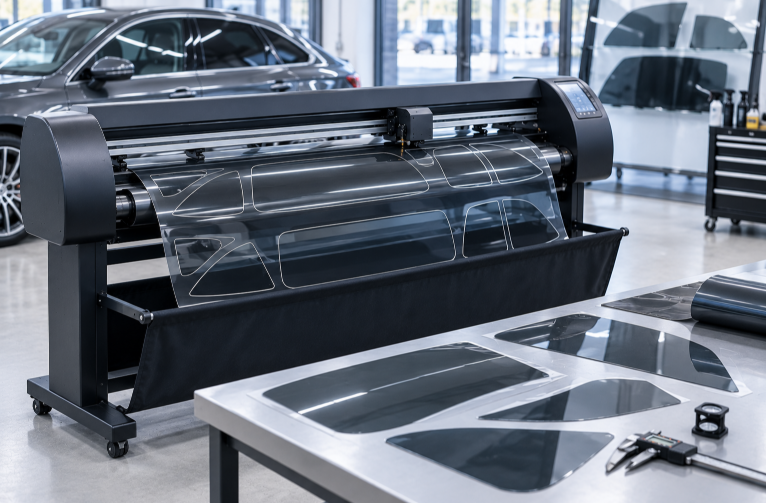
A window film cutting machine is a computer-controlled cutter that prepares tint, PPF or related automotive film before installation. For a tint shop, the right choice is normally a roll-fed film cutting plotter with stable tracking and controllable blade depth. If the shop also processes thicker flexible media, printed graphics, full-cut parts or multiple cutting operations, a roll-feeding flatbed cutter may be a better category to compare. The decision should follow the shop’s actual film mix and installation workflow.
1. Define What the Tint Shop Actually Cuts
Window film can describe several constructions with different handling requirements. Before comparing machines, list the regular jobs:
| Job type | What to document before buying |
|---|
| Automotive window tint | Film width, liner construction, pattern size, cut depth and whether the liner must remain intact |
| Paint protection film (PPF) | Film thickness, adhesive behavior, large contours, small tabs and required release method |
| Vehicle wrap or decorative film | Roll width, long tracking distance, printed surface, laminate and edge quality |
| Reflective or safety film | Surface finish, optical registration, cut force and waste removal |
| Small decals or shop graphics | Detail size, kiss-cut requirement, weeding method and finished format |
The current search results for tint-shop plotters emphasize a practical buyer question: can one system handle the shop’s mix of window tint, PPF and vinyl without creating a second manual workflow? That is more useful than asking which machine is “best” in isolation. VICUT’s roll feeding cutting plotter range is positioned for automotive aftermarket work and lists window tint, PPF, reflective film and self-adhesive vinyl as separate application categories.
2. Compare the Main Machine Categories
| Machine category | Usually fits first | Check carefully before purchase |
|---|
| Roll-fed film cutting plotter | Window tint, PPF patterns, vinyl and long contour or kiss-cut jobs | Tracking, cut depth, width, software, static and liner protection |
| Roll-feeding flatbed cutter | Flexible media requiring a conveyor or flat cutting zone, full cuts, perforation or multiple operations | Hold-down, vacuum, material thickness, tool configuration and output handling |
| Static flatbed cutter | Pre-cut sheets, boards, packaging samples and irregular flat media | Manual loading, usable bed size and whether roll input is supported |
| Manual table or hand cutting | Occasional one-off work or emergency repairs | Repeatability, labor time, edge consistency and rework |
Do not treat a roll plotter and a conveyor flatbed as interchangeable. A plotter may be the simpler fit when the output is a weedable pattern on a liner. A conveyor or flatbed may be more suitable when the shop needs separated pieces, perforation, marking or wider material handling. The VICUT roll feeding flatbed cutter category describes a different media path and operation set from its film cutting plotter range.
3. Six Buying Factors That Matter in a Tint Shop
Working width and roll handling
Match the usable cutting width to the widest regular tint or PPF pattern, not just the nominal roll width. Leave room for alignment, edges and any registration marks. Confirm the maximum roll weight, outside diameter, core size and loading direction. A shop that frequently changes film widths should also ask how quickly the roll bracket and guides can be adjusted.
Tracking over long patterns
Long windshields and vehicle panels expose tracking problems that a short sample can hide. Ask the supplier to demonstrate a long pattern, then measure the beginning, middle and end of the cut. The test should record skew, drift, edge lift and any need for operator correction. The GC-180 PPF vinyl cutting plotter is a model-specific example of a cutter page that distinguishes automotive film applications from general vinyl work; do not transfer its functions or limits to another model without checking that model’s page.
Cut depth and liner protection
Tint and PPF jobs often need a controlled kiss cut rather than a through cut. The blade must separate the film or adhesive layer without damaging the liner more than the workflow allows. Test corners, narrow slots, tabs, compound curves and repeated patterns. If the shop needs both kiss cuts and full cuts, request a file with both path types and ask how the software assigns them.
Static, curl and surface behavior
Thin films can lift, curl or shift because of static, temperature, storage or adhesive behavior. Observe the material during loading and cutting, not only the final pattern. Ask whether the machine has documented procedures for static-sensitive media, roller pressure, hold-down and material preparation. Do not assume a machine suitable for unprinted vinyl will behave identically on a coated, laminated or metallic film.
Software and pattern workflow
Tint shops should evaluate how patterns are imported, scaled, nested, labeled and recalled. Check supported file formats, barcode or job-retrieval options, template-library compatibility and the steps required to send a repeat job. The software should make it easy to separate the cut path from notes, labels or non-cutting artwork. A fast machine still creates rework if a pattern is scaled incorrectly or the wrong film preset is selected.
Support and sample testing
Ask which blades, holders, software licenses and training are included. Confirm the escalation path when a pattern fails or a material changes. Support should be discussed together with a sample test: the supplier needs the real film, artwork, roll width and desired cut depth to make a useful recommendation.
4. Build a Tint-Shop Acceptance Test
Send the same test package to each supplier. Include:
one simple window contour;
one long windshield or rear-window pattern;
one pattern with tight curves and narrow tabs;
the smallest regular detail used in production;
the most difficult film construction in the shop;
a repeated job to check saved settings and pattern consistency;
any job that needs both kiss cutting and a through-cut or weed border.
Record loading time, pattern scaling, mark or origin setup, cutting time, operator intervention, liner condition, weeding quality and waste. Measure more than the machine’s maximum speed. A useful result is the number of accepted, installation-ready patterns after the complete workflow—not the speed of an empty carriage.
For a wider purchasing framework, the roll feeding flatbed cutter buying guide explains how material, cut type, registration, feeding and real production tests should be compared. Tint shops should apply the same discipline to their own film rather than relying on a generic application list.
Which Window Film Cutter Fits Which Shop?
| Shop profile | Starting category to evaluate |
|---|
| Mostly window tint patterns with liner-preserving cuts | Roll-fed film cutting plotter |
| Tint plus PPF and vehicle-wrap film in several widths | Wider roll-fed plotter with verified tracking and film handling |
| Automotive film plus full-cut graphics, perforation or flexible media | Roll-feeding flatbed cutter |
| Mostly sheets, packaging samples or rigid boards | Static flatbed or sheet-fed cutter |
| High variation and uncertain materials | Compare two categories with the same sample-test package |
This table is a starting point, not a universal model recommendation. The final choice should be tied to the actual material, cut path, roll size, software and installation output.
Frequently Asked Questions
Can a vinyl cutter cut window tint film?
Some roll-fed vinyl cutters are designed for film applications, but compatibility depends on the model, blade, film construction and cut-depth control. Test the actual tint film and liner before production.
Do tint shops need a PPF-specific cutter?
Not always. A machine may support both PPF and window tint, but the shop should confirm width, tracking, blade control, software and template workflow on the quoted model. PPF and tint should not be treated as identical materials.
Is a wider cutting machine always better?
No. Width should match the shop’s regular patterns and roll handling. An oversized machine can add cost and floor-space requirements without solving the shop’s main problem.
What should I send when requesting a quotation?
Send film samples, roll width and core information, representative pattern files, required cut depth, expected output, daily job mix and any template or software requirements. Ask for a written model-specific test plan.
Request a Model-Specific Film Test
If you are comparing a window film cutting machine for a tint shop, send VICUT the film construction, roll dimensions, pattern files and required installation output. The team can help identify whether a roll feeding cutting plotter or a roll-feeding flatbed configuration should be tested. Contact VICUT with the sample package before approving a quotation.
 vicutcnc@cncvicut.com