Key Takeaways
Choose a roll feeding flatbed cutter from the material format and required output, not from the product name alone.
Confirm whether the job needs full cutting, kiss cutting, perforation, marking, creasing or more than one operation.
Check working width, material thickness, registration, feeding stability and tool configuration against real jobs.
Separate DTF, PPF, reflective film, signage and packaging requirements before comparing models.
Request a sample test and written configuration list before approving a purchase.
A roll feeding flatbed cutter is a digital cutting system that automatically advances flexible roll media onto a cutting table or conveyor. It is useful when a business needs more than a basic vinyl plotter: for example, contour cutting, full cutting, kiss cutting, perforation or marking on printed and unprinted flexible materials. The right choice depends on the material, finished format, cutting method, job length and required workflow—not simply the advertised cutting speed.
1. Start With the Production Workflow
Define how material enters the process and what the finished product must look like.
| Regular production condition | Category to evaluate first |
|---|
| Printed DTF film that needs contour or separated-piece cutting | DTF-oriented roll feeding flatbed cutter |
| PPF, vehicle wrap, window tint or reflective film | Roll feeding flatbed cutter or film cutting plotter, depending on the cut type and width |
| Traffic signs, floor graphics and large decals | Conveyor flatbed cutter with suitable registration and hold-down features |
| Printed or unprinted rolls requiring long continuous feeding | Automatic roll-feeding cutter with stable media handling |
| Single sheets, cards, packaging samples or rigid boards | Static flatbed cutter or sheet-fed cutter |
| Long vinyl lettering and mainly kiss-cut output | Roll feeding cutting plotter |
This distinction prevents a common buying mistake: treating every machine called a “flatbed cutter” or “plotter cutter” as interchangeable. VICUT separates its roll feeding flatbed cutter, roll feeding cutting plotter and static flatbed cutter categories because their media paths and production tasks differ.
2. Understand What the Machine Must Cut
Write the required operations into the quotation and sample-test request.
Full cut / through cut: cuts through the complete material construction.
Kiss cut / half cut: cuts the face material while preserving the liner or backing.
Perforation: creates controlled separation or tear lines.
Marking: adds a visible reference or production mark without necessarily cutting through.
Creasing: forms a fold line and requires a suitable tool; it should not be assumed because a machine has a cutting blade.
The same job may combine more than one depth or operation. Ask how the software assigns different paths, how the tool head changes between operations and how the operator checks the result. A supplier should demonstrate the actual combination on the material you plan to sell.
3. Match the Cutter to the Material
Material names such as “film” or “vinyl” are too broad for a final machine decision. Record the exact construction:
face material and thickness;
liner, adhesive or backing;
coating or laminate;
roll width and outside diameter;
printed or unprinted condition;
required cut depth and edge quality.
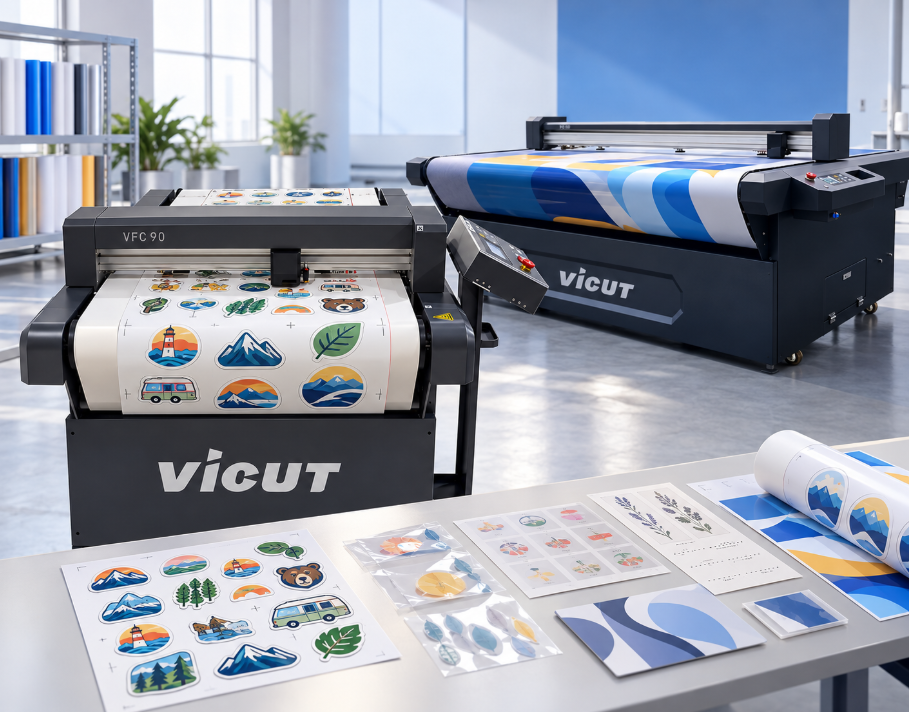
For example, the VICUT VFC90 DTF flatbed cutter is presented for DTF and other soft or medium-rigidity media, while the VFR series documentation lists applications including reflective film, PPF, vehicle wrap, window tint, vinyl, PET, PVC, traffic signs and packaging. These are model or series references, not a universal compatibility claim for every cutter.
Kongsberg also explains that material compatibility depends on the machine’s tooling and configuration, while Summa highlights the need to control tension and movement when flexible media shifts or curls. Use these principles to define a sample test rather than approving a material from its trade name alone.
4. Compare the Important Machine Factors
Working width and finished size
Choose a width that fits the largest regular job, including registration margins and waste handling. Do not select the narrowest model that only fits an occasional job. At the same time, an oversized machine can add floor-space, power and handling requirements that your normal work does not need.
Registration and print-to-cut alignment
Printed graphics can stretch, skew or shift during printing, laminating and feeding. Ask whether the quoted model uses a camera or another registration method, which marks it reads and how it handles difficult surfaces. Test small text, narrow borders, long repeats and graphics close to the edge.
Feeding and hold-down
Check the roll bracket, conveyor, rollers, vacuum or other hold-down method. Thin films, laminated graphics and reflective media can behave differently from unprinted vinyl. A good test should include a short job and a longer job so that tracking is assessed across the actual production length.
Tool heads and cutting force
Multiple tool positions may help when a job combines different depths or cutting and creasing. However, a second head does not automatically double output. Ask which tools are included, which materials each tool is intended for and how force is adjusted.
Software and job changeover
Review supported file formats, plug-ins, barcode or QR-code workflows, saved presets and offline operation. Observe the complete changeover: import the file, read the marks, assign operations, run the job, recover from a stop and repeat it. The fewer unplanned manual handoffs, the easier it is to maintain consistent production.
5. Run a Real Sample Test Before Buying
Provide the supplier with the same files and materials used in production. A useful acceptance test should include:
the smallest regular detail;
the longest regular roll or repeat;
the most difficult material construction;
full cut and kiss cut where both are required;
registration across several positions;
edge quality, liner protection and waste removal;
setup, calibration, changeover and recovery time.
Record the machine model, installed tools, material, settings and output. Do not convert a headline maximum speed into a production promise. Usable throughput also includes loading, mark reading, setup, rejected pieces, material changes and operator handling.
6. Calculate the Complete Configuration Cost
Compare more than the base machine price:
| Cost area | Questions to confirm |
|---|
| Machine | Which model, head configuration and sensors are included? |
| Tools | Which blades, holders, creasing tools and spares are supplied? |
| Software | Which licenses, plug-ins, computers and updates are required? |
| Utilities | What power, floor space, network or air requirements apply? |
| Workflow | Is lamination, waste removal, slitting, rewinding or sheeting manual? |
| Support | What training, documentation and technical response are included? |
Do not accept a fixed ROI or payback statement without your own order volume, labor cost, material waste and margin data. A written configuration list and test report are more useful than a generic “best machine” ranking.
Which VICUT Machine Should You Review?
Start with the VICUT roll feeding flatbed cutter range. Review the VFC90 when the primary workflow is DTF film or similar flexible media. Review the VFR product pages when the work involves wider automotive film, reflective film, signage, packaging or other roll-fed applications. The final recommendation should be tied to your material sample, finished size, cut type and daily job mix.
Frequently Asked Questions
Is a roll feeding flatbed cutter the same as a vinyl cutter?
No. A vinyl cutter is commonly used for roll-fed contour or kiss cutting. A roll feeding flatbed cutter may provide a conveyor or flat cutting zone and support additional operations, but the exact functions depend on the model and installed tools.
Can one machine cut DTF film and PPF?
Some configurations may be suitable for both, but this must be confirmed with the exact model, material construction and sample test. DTF film, PPF and laminated vehicle film should not be treated as identical materials.
Should I choose a single-head or dual-head model?
Choose according to the operations that must be completed in the same job. Compare the tool combination, changeover process and tested output rather than assuming that more heads automatically mean higher productivity.
What should I send when requesting a quotation?
Send the material name and thickness, roll width, print or laminate status, artwork file, required cut type, finished size, normal batch size and any output or packing requirements.
Request a Model-Specific Test Plan
Not sure which roll feeding flatbed cutter fits your material? Send VICUT your sample material, roll width, artwork, required cut operations and expected output. The team can help define a model-specific test and configuration list before you compare quotations. Contact VICUT to start the discussion.
 vicutcnc@cncvicut.com