A photo cutter and a business card cutter may look similar because both process printed sheets and cut them into small rectangular pieces. Their workflows, however, are built around different types of jobs. A photo cutter is mainly designed for ID, passport, visa and other document photos, while a business card cutter is designed to separate repeated card layouts from printed sheets.
For print shops, photo studios and document-photo services, the better choice depends on the products being produced, the paper being used, the required finished sizes and how often the machine needs to change between jobs.
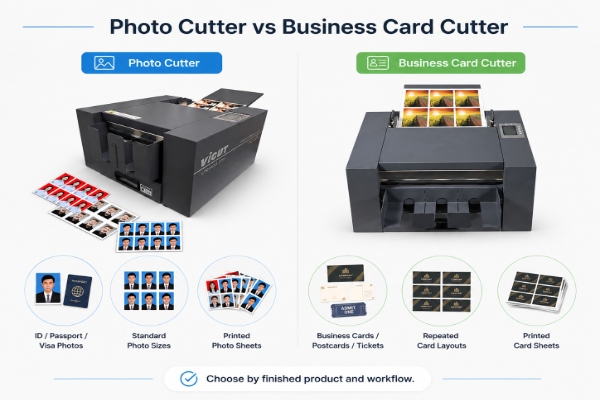
Photo Cutter vs Business Card Cutter: Quick Comparison
| Decision Point | Photo Cutter | Business Card Cutter |
|---|
| Primary application | ID, passport, visa and certificate photos | Business cards, postcards, tickets and similar products |
| Typical input | Printed photo sheets | Imposed business card sheets |
| Main size requirement | Standard document-photo formats | Customer-defined finished card sizes |
| Layout | Multiple photos on one sheet | Repeated rows and columns |
| Key considerations | Photo size, template, photo paper and feeding | Card size, imposition, stock and cutting layout |
| Typical users | Photo studios and document-photo services | Commercial printers and print shops |
| Additional functions | Photo templates, automatic feeding and counting | Cutting, creasing or perforating depending on model |
The important difference is not simply the word “card.” It is the finished product and production workflow the machine needs to handle.
What Is a Photo Cutter Used For?
A photo cutter machine is used to cut printed photo sheets into standard document-photo sizes. Common applications include passport photos, visa photos, ID photos, certificate photos and other small-format photographs.
Instead of trimming every photograph separately, several images are printed on one sheet and then cut automatically. This makes a passport photo cutter or ID photo cutter machine useful when the same photo formats are produced repeatedly throughout the day.
Depending on the model, a photo cutting machine may provide:
The available photo sizes should be checked before purchasing. Passport photo sizes, visa photo sizes and ID photo sizes vary between countries, so a template available on one machine may not cover every format required by a particular market.
Photo paper is another important consideration. Glossy and coated photo papers can behave differently during feeding and cutting, especially when the sheets are thick, curled or prone to static. A proper test should therefore use the same paper and printing process used in regular production.
How Does a Photo Cutter Machine Work?
A typical automatic photo cutter starts by feeding a printed sheet into the cutting area. The machine identifies the sheet position or follows a predefined cutting layout, then makes a series of cuts to separate the individual photographs.
The exact process varies by machine. Some models use preset templates for common photo dimensions, while others provide more flexibility for different layouts.
For a photo studio, the practical questions are usually straightforward:
Which passport and ID photo sizes are available?
Can several photo formats be used on the same machine?
How many sheets can be loaded at one time?
Can the machine feed sheets by a specified quantity?
How does it handle the shop's actual photo paper?
How are finished photos collected and counted?
These points are often more useful than looking at cutting speed alone.
What to Check When Buying a Passport Photo Cutter
When comparing passport photo cutter machines, start with the photo sizes that are actually sold in the target market. Record the most common formats and the number of copies normally requested per order.
Then check whether the machine supports those sizes through standard templates or requires a different cutting configuration.
It is also worth testing:
Actual printed photo sheets
Different photo-paper thicknesses
Glossy and matte surfaces
Slightly curled sheets
Different sheet sizes
Small and large batch quantities
For shops handling many individual customers, feeding and counting can be just as important as cutting accuracy. A machine that cuts well but requires frequent manual alignment or sorting may not provide the expected labor savings.
The Vicut PC-220, for example, is designed for passport photos, ID photos and other small-format photo applications. Its configuration includes preset cutting templates and automatic feeding options for different production quantities.
What Is a Business Card Cutter Used For?
A business card cutter machine is designed to separate multiple business cards printed on a larger sheet into individual finished cards.
A typical print layout contains several rows and columns of cards. The machine makes longitudinal and cross cuts according to the layout, separating the cards while reducing the manual trimming required after printing.
Business card cutters are commonly used for:
The exact applications depend on the cutting size, cassette, tooling and material range of the machine.
For a commercial printer, the main concern is usually not whether the machine can cut a rectangle. It is whether the machine can process the actual card size, sheet size, imposition and paper stock used in production.
What to Consider When Buying a Business Card Cutter?
When choosing a business card cutting machine, first list the card sizes and sheet layouts currently used by the print shop.
For example, check:
Finished business card dimensions
Sheet dimensions
Number of rows and columns
Gutter width
Bleed requirements
Paper thickness
Coated or uncoated stock
Single-sided or double-sided printing
Required creasing or perforation
The cutting configuration should then be matched to these production files.
A business card cutter may use a specific cassette or cutting layout for a particular card arrangement. If a print shop regularly switches between several business card sizes, the time and effort required for changeover should be included in the evaluation.
Registration control can also be useful when printed content is not perfectly positioned on the sheet. However, it does not replace correct imposition, sufficient bleed or proper print registration. The best test is to run the machine using the print shop's own files and printed sheets.
Photo Cutter vs Business Card Cutter: Key Workflow Differences
1. Finished Product Size
The biggest difference between a photo cutter and business card cutter is how finished sizes are determined.Photo cutting is often based on established document-photo formats. A photo studio may repeatedly produce the same passport or ID photo dimensions.Business card production is more flexible. Finished sizes can vary between customers, and the cutting pattern depends on how the cards are imposed on the printed sheet.
2. Cutting Layout
A photo cutting machine commonly works with predefined photo templates. Several images may have the same or different sizes depending on the supported layout.A business card cutter normally follows a repeated grid. The cutting pattern is closely connected to the number of cards arranged across and down the sheet.
3. Paper and Material
Photo cutters are generally used with photographic paper or similar coated media. Surface finish, thickness, curl and static can affect sheet feeding.Business card cutters may handle a wider range of print stocks, including coated paper, uncoated card stock and heavier materials, depending on the machine specification.
4. Changeover Requirements
A photo studio may only need a few common photo formats, so a machine with readily available photo templates can simplify daily operation.A commercial print shop may handle many different card layouts. In this case, cassette changes, cutting configurations and file setup can have a greater effect on productivity.
5. Collection and Order Separation
Cutting is only one part of the workflow.A photo studio may need to keep different customers' photo sets separate and count the required number of photographs for each order. A print shop may need to collect hundreds or thousands of cards without mixing different jobs.The output tray, set-count feeding, waste separation and finished-product handling should therefore be checked during a machine demonstration.
Photo Cutter or Business Card Cutter: Which One Should You Choose?
Choose a photo cutter machine when the main workload is passport photos, ID photos, visa photos or other standardized document photographs.
Choose a business card cutter when the main workload consists of repeated business card layouts and other rectangular printed products.
If the shop handles a broad mix of products, especially products with irregular shapes or different finishing requirements, consider a digital sheet cutter or flatbed cutter instead.
The final decision should be based on the jobs the machine will actually run. Compare the required sizes, printed materials, cutting layouts, changeover frequency and output handling before selecting the machine configuration.
FAQ
Q1:What are the different printing options for business cards?
Common options include digital printing, offset printing, and specialty finishes such as matte, gloss, foil, and spot UV.
Q2:What is the best paper cutting machine?
The best paper cutting machine depends on the material, sheet size, cutting accuracy, production volume, and type of finished product.
Q3:What is a card cutter?
A card cutter is a machine that cuts printed sheets into individual cards, such as business cards, membership cards, and tickets.
Q4:What's cut by a card cutter?
Card cutters typically cut business cards, postcards, tickets, membership cards, and other small rectangular printed products.
 vicutcnc@cncvicut.com