Select packaging die cutting equipment by working backward from the finished blank: its board, dimensions, cut and crease requirements, batch pattern and downstream handling. A digital cutter can be practical for prototypes and variable short runs; a physical-die press may merit evaluation for repeat production. Neither category is automatically cheaper or faster for every converter. Compare tested output, quality and total job cost on the same work.
Key Takeaways
● Specify the packaging construction and finished blank before comparing machine names or advertised speed.
● Digital knife cutting and physical-die presses differ in tooling and setup; the decision depends on the actual order mix.
● Paperboard grade, thickness, grain, coatings and print registration affect feeding and fold quality.
● Cutting, creasing, perforation, stripping and collection are separate requirements, not guaranteed features of every machine.
● Request a sample test and itemized configuration using the same production files and materials for every supplier.
Start With the Packaging You Need to Deliver
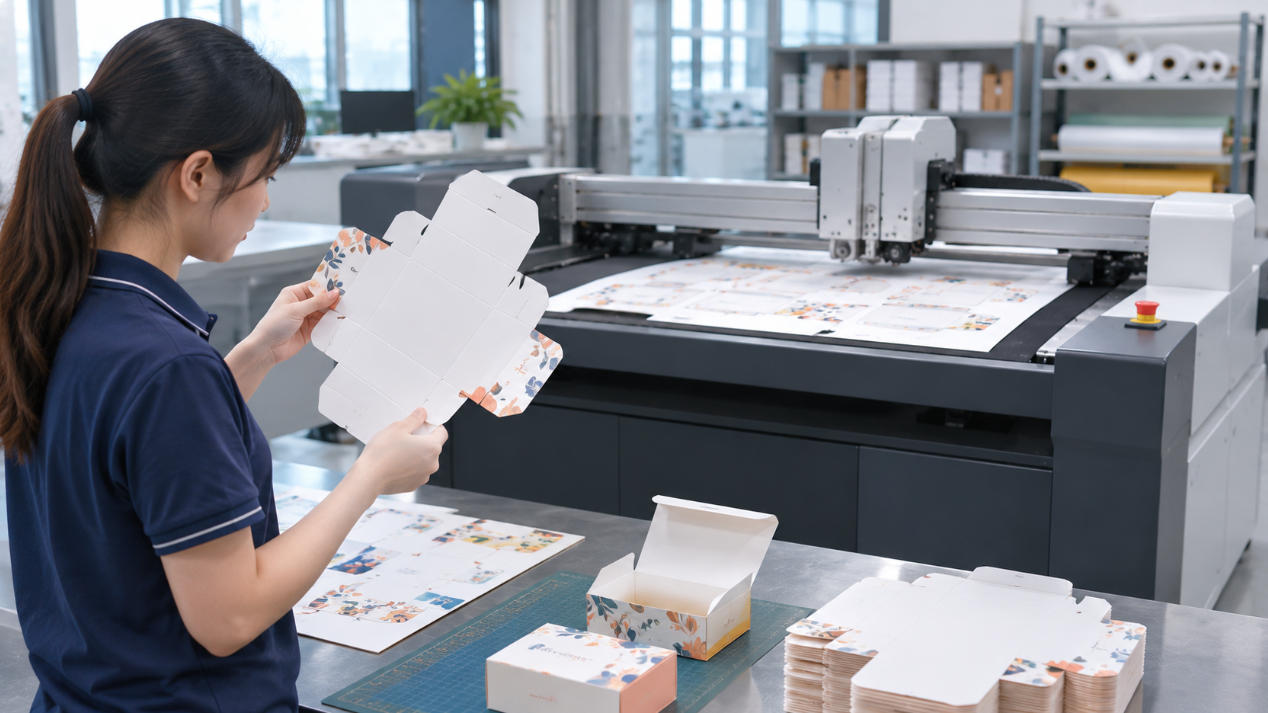
A converter making a folding-carton sample faces a different task from a plant cutting long runs of one established box. List finished blank dimensions, print condition, board type and thickness, required folds, cutouts, perforations and delivery format. Include how blanks will be stacked, counted, glued or assembled after cutting.
Use the VICUT cutting equipment overview to identify relevant categories, then verify each model's working area, tools and material limits. A product category is a starting point, not proof that a specific board or box design can be processed.
Compare Equipment by Production Requirement
| Job pattern | Equipment route to investigate | Important limitation or test |
|---|
| One-off carton prototypes and revisions | Suitable digital flatbed cutter | Bed size, crease quality and file preparation |
| Repeated stacks of printed light packaging | Suitable automatic sheet-fed digital cutter | Board feeding, registration and stacking |
| Stable, high-volume repeated carton design | Physical-die flatbed or rotary press | Tooling, setup, repeat compatibility and stripping |
| Printed labels plus packaging samples | Suitable sheet-fed or flatbed digital configuration | Confirm tools and construction for each product |
A physical flatbed die press, a rotary die press and a digital flatbed cutter do not use the same cutting action. A conventional die contains the shape in physical tooling; a digital blade follows a file. Rotary describes the tooling action in a rotary die press, whereas “roll-fed” alone only describes how media enters a machine.
Check Board Behavior, Not Just GSM
Weight per area is useful for screening, but it does not fully describe thickness, stiffness or how a board will fold. Provide the board specification, grain direction, coating or laminate, print coverage and expected storage condition. A machine may accept the nominal sheet size yet struggle to separate a curled or coated stack.
Ask the supplier to test the actual material rather than a generic substitute. Inspect the start, middle and end of a representative batch for feeding marks, double sheets, cut quality and print-to-cut alignment. For a printed blank, registration marks must remain visible and compatible with the quoted system.
Specify Every Operation and Tool
Through cutting defines the outer blank and internal openings. Creasing prepares a fold; it needs the right tool and settings for the board, not simply a blade with extra pressure. Perforation creates a controlled tear or separation line. If adhesive labels share the job, kiss cutting must leave a usable liner.
Mark each operation separately in the production file and ask how the system assigns it to a tool. Make a physical sample and fold it as the customer would. Look for cracking, inaccurate folds, incomplete cuts and damaged printed edges. The VICUT VSC-350Pro sheet cutter page describes cutting, kiss cutting, creasing and perforating on selected sheet materials including thin packaging; confirm the actual board and installed configuration before ordering.
A machine that can cut a board does not necessarily produce an acceptable crease or handle every package structure. Thick corrugated stock, rigid board and complex carton production require their own model-specific assessment.
Calculate the Complete Job, Not a Headline Speed
Compare the full order: artwork preparation, tooling if required, setup, test sheets, feeding, cutting, creasing, waste removal, stacking, inspection and changeover. For a physical die, include manufacture, storage, repeat use and revisions. For a digital system, include file preparation, path complexity, tools and operator intervention. Include rejected blanks and missed downstream requirements.
There is no universal break-even quantity. Use a representative short-run job and a recurring long-run job, and compare the same quality standard and delivery format. The existing packaging digital cutting versus die cutting comparison introduces the two processes; a purchasing decision still needs a job-specific calculation rather than a fixed winner.
Build a Supplier Acceptance Test
Send each supplier the same materials and a production-ready file. Include the smallest cutout, a long cut, the most demanding fold, printed marks and any perforation or mixed-depth path. Request a batch, not a single demonstration piece.
Record the machine and tool configuration, usable sheet area, setup and changeover time, accepted blanks, feed interruptions and waste. Fold and assemble samples, inspect print alignment and confirm that collection preserves orientation and count. Keep the test conditions with the quotation so a later configuration change does not invalidate the comparison.
Frequently Asked Questions
Is a digital cutter suitable for packaging production?
It can suit prototypes and some short-run or variable jobs when its material, size, tools and throughput meet the order. Verify the exact model and finished blank with a production sample.
Do all packaging cutters crease as well as cut?
No. Creasing requires a suitable tool and configuration. Confirm the included tool, supported board and fold quality in the quotation and sample test.
Is a rotary die cutter the same as a roll-fed digital cutter?
No. A rotary die cutter uses shaped rotary tooling; roll-fed digital equipment may use moving knives following a file. Ask the supplier to identify the actual mechanism.
What should a converter include in an RFQ?
Provide job quantities and frequency, sheet or roll dimensions, board and coatings, artwork, required cuts and folds, registration, accepted quality, output handling and space or support constraints.
Turn the Specification Into a Useful Quote
Shortlist equipment only after the material and finished blank are defined. Contact VICUT with representative files, printed board samples and the required operations to discuss a model-specific configuration and sample test.
 vicutcnc@cncvicut.com