Key Takeaways
Kiss cutting cuts the facestock and adhesive but preserves the release liner, so labels stay organized on a roll or sheet and peel for application.
Full cutting, also called through cutting, cuts through the complete construction and creates a separated piece or an outer sheet shape.
One job can contain both: kiss-cut label contours inside a full-cut outer sheet.
The correct setting depends on the exact facestock, adhesive and liner; copying a force value from another material is not a production method.
Judge output by peelability, liner strength, edge quality, matrix stripping and downstream handling—not by appearance alone.
Choose kiss cutting when the label must remain on its liner until application. Choose full cutting when the finished item must leave the machine as a separate piece, or when the outer boundary of a sticker sheet must be cut through. These terms describe cut depth, not whether the job is roll-fed, sheet-fed, digital or conventionally die-cut.
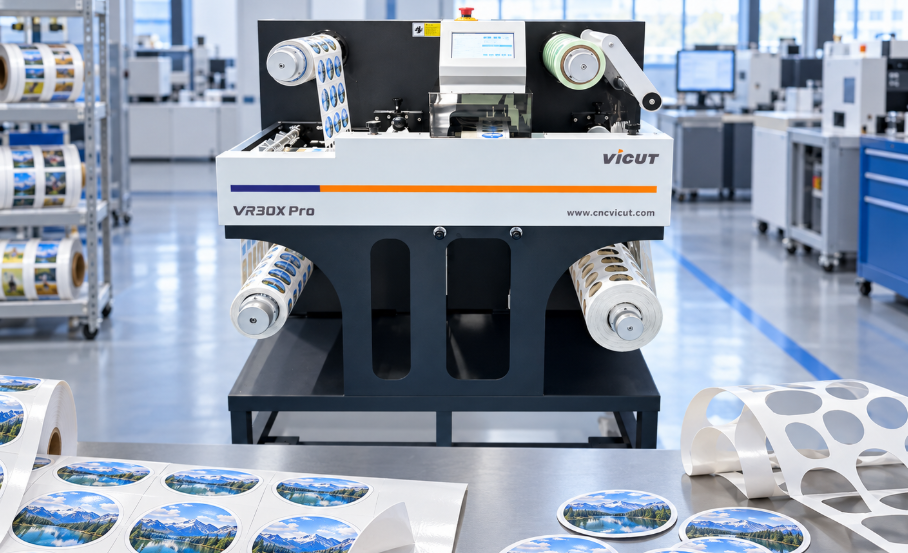
Kiss Cut vs Full Cut: Quick Comparison
| Factor | Kiss cutting | Full cutting / through cutting |
|---|
| Cut depth | Through facestock and adhesive | Through facestock, adhesive and liner |
| Output | Labels remain on continuous liner | Separate pieces or full-cut sheet outlines |
| Typical use | Product labels, decals, sticker sheets | Individual stickers, tags, outer sheet shapes |
| Critical control | Clean release without weakening liner | Complete separation and control of loose pieces |
| Main production risk | Uncut adhesive or liner damage | Parts shifting, dropping or disrupting transport |
What Is Kiss Cutting?
A pressure-sensitive label normally combines a facestock, adhesive and release liner. In kiss cutting, the blade or die passes through the upper layers and stops at the liner. The liner carries the converted labels through matrix removal, slitting, rewinding, packing and application.
A successful kiss cut is not simply a shallow visible line. The label must peel cleanly around the complete contour, while the liner remains strong enough for handling or dispensing. If pressure is too low, the adhesive or facestock may bridge. If pressure is too high, the liner may be scored, embossed or cut through.
What Is Full Cutting?
Full cutting passes through every layer. It is appropriate when a sticker, tag or other shape must be separated from the surrounding construction. On a sheet label job, full cutting may define the outside of the sheet while the stickers inside it are kiss-cut.
Through-cut pieces need a handling plan. Small parts can move after separation, fall into a machine, interfere with the next sheet or become difficult to count. Ask how the cutter holds the material, retains tabs if needed, collects pieces and manages waste.
Can the Same Job Use Both Cut Types?
Yes. A common example is an easy-peel sticker sheet: the inner sticker contours are kiss-cut, while the outer sheet shape is fully cut. The cutting file must identify the two operations, and the machine must apply the appropriate tool, pressure or pass strategy.
That capability is configuration-specific. Do not assume every roll label cutter can deliver loose full-cut pieces while maintaining a continuous web. For roll-fed work, preserving the liner is often essential to transport and rewinding. For mixed-depth sheet work, a sheet-fed or flatbed configuration may provide easier piece control. Confirm with a real sample.
For stacks of printed sticker sheets, compare the VICUT autofeeding sheet label cutter range as a separate workflow from roll-fed finishing.
Why the Liner Changes the Result
Liners vary in material, thickness, strength, release level and surface. A setting that works on one laminate may damage another. Even material from a familiar category can behave differently after a supplier, coating or batch change.
Avery Dennison’s thin-film liner converting bulletin provides a useful quality-control model. It advises checking the die imprint for every cavity, avoiding pressure that deforms the liner and performing web-strength checks. The bulletin’s stated settings and 0.92-gauge context belong to that named construction; they must not be copied to unrelated stocks.
UPM Raflatac also publishes technical recommendations for self-adhesive sheets, reinforcing the need to follow material-specific converting and storage guidance.
Production Quality Checklist
| Check | Acceptable result | Warning sign |
|---|
| Peel test | Label releases around full contour | Fibers, adhesive strings or uncut corners |
| Liner inspection | Liner remains functional | Deep score, embossing, tears or holes |
| Matrix removal | Waste lifts without label pickup | Matrix breaks or labels lift with waste |
| Edge | Clean contour for the material | Ragged, lifted or adhesive-smeared edge |
| Registration | Cut remains aligned to print | Drift across the roll or sheet |
| Output handling | Parts stay controlled and ordered | Loose pieces shift, drop or mix |
Inspect the start, middle and end of a roll or stack. A single approved piece does not show whether tension, heat, blade wear or material variation will change cut depth over time.
How to Set Up a Sample Test
Use the actual printed file and laminate. Include small radii, corners, fine details and the largest regular contour. Begin with the documented setup procedure, make a short test, inspect both label and liner, then change only one variable at a time. Record blade, tool holder, exposure, pressure/force, speed, passes, material batch and operator.
For roll labels, continue through matrix stripping and rewinding. A label that peels at the cutting station may still fail when the matrix breaks or the liner tears under tension. For sheets, test feeding and collection after through-cut pieces are created.
Choosing Equipment for Kiss and Full Cutting
When comparing a VICUT roll label die cutting machine, specify whether the job is roll-to-roll kiss cutting, roll-to-sheet output or mixed-depth sheet work. Ask the supplier to identify the cutting mechanism, depth-control method, registration workflow and finished-piece handling.
Do not select by maximum force alone. For kiss cutting, controllability and repeatability are more important than a large force number. For full cutting, the system must separate the material without losing control of parts. VICUT can evaluate actual files and media before quotation; send samples from normal production rather than an easy substitute.
Frequently Asked Questions
Is kiss cutting a type of die cutting?
Yes. Kiss cutting describes a controlled-depth die-cutting or digital-cutting operation that preserves the liner.
Is a die-cut sticker always full cut?
In consumer sticker language, “die cut” often means a sticker trimmed through the backing to its outer shape. In production, die cutting is broader and also includes kiss cutting. Specify the required layers and output.
Can a roll label cutter full-cut individual stickers?
Some configurations may support through-cut operations, but loose pieces can conflict with web transport and rewinding. Verify the exact model and output handling with a sample.
What causes inconsistent kiss cutting?
Possible causes include blade wear or exposure, pressure, material variation, liner thickness, web tension, debris, heat and an uneven cutting surface. Diagnose the system rather than increasing force automatically.
Confirm Cut Depth on Your Actual Material
Send VICUT the facestock, adhesive, liner, laminate and artwork with each contour identified as kiss cut or through cut. Also state whether the output must remain on a roll, stay on a sheet or leave as individual pieces. Contact VICUT to arrange a model-specific sample test and inspect both the finished face and liner before selecting a label cutting system.
 vicutcnc@cncvicut.com