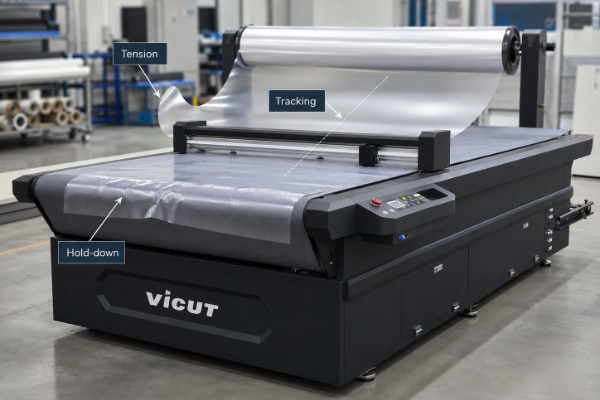
Most curling, wrinkling, and feed drift problems on a roll feed flatbed cutter come down to three root causes: uneven web tension, poor media tracking through the conveyor, and mismatched vacuum or pressure settings for the material being cut. Fix those three variables — tension, tracking, and hold-down — and the majority of roll-fed film issues disappear without needing to slow down production. Below, we walk through why these problems happen, how to diagnose them quickly, and the specific machine settings that keep thin, flexible films like vinyl, reflective film, and heat transfer material feeding flat and true.
Why Roll-Fed Films Curl, Wrinkle, or Drift
Roll-fed materials behave very differently from rigid sheet stock. Thin films such as PVC, PET, reflective vinyl, and heat transfer material have low structural stiffness, which means small inconsistencies in tension or airflow show up immediately as visible defects. On a roll feed flatbed cutter, the film travels from the roll, across a conveyor or vacuum table, under push rollers, and through the cutting zone — and any imbalance at any one of those stages can compound into a bigger problem downstream.
The three most common failure patterns are:
Curling — the film edges lift or roll inward, usually caused by uneven tension across the roll width or a film that hasn't relaxed after unwinding.
Wrinkling — soft creases or folds appear as the film moves through the conveyor, typically from mismatched roller speed, low hold-down suction, or a web that isn't centered.
Feed drift — the material gradually shifts sideways or the cut registration walks off-position over the length of the roll, often from uneven push-roller pressure or a media bracket that isn't set for the film's width and thickness.
How to Diagnose the Problem Quickly
Rather than adjusting multiple settings at once, work through the machine in the direction the film travels — from the roll holder to the cutting head — and isolate where the defect first appears.
Check the unwind first. If the roll itself is wound unevenly or the film was stored with inconsistent tension, curling can appear before the material even reaches the machine.
Watch the conveyor entry point. Wrinkles that appear right as the film enters the table usually point to a hold-down or centering issue, not a downstream setting.
Mark a reference line and observe drift over length. If registration walks consistently in one direction over several meters, push-roller pressure or bracket alignment is almost always the cause.
Isolate by changing one variable at a time. Adjust tension, vacuum, or roller pressure individually and re-run a short test length before making a second change.
Machine Settings That Prevent Curling, Wrinkling, and Feed Drift
| Problem | Likely Cause | Recommended Fix |
|---|
| Curling edges | Uneven roll tension | Balance tension across the full roll width before feeding |
| Center wrinkles | Low vacuum/air hold-down | Increase suction to hold film flat against the table |
| Edge wrinkles | Web not centered | Adjust media bracket to guide film evenly on both sides |
| Sideways drift | Uneven push-roller pressure | Set push rollers to matching pressure levels on both sides |
| Registration walk over length | Bracket not matched to film width | Reset media bracket for the specific film width and thickness |
| Static-related feed issues | Friction on thin films | Use an anti-static or low-friction feed setting for thin material |
Best Practices for Feeding Roll Media on a Flatbed Cutter
Match hold-down strength to material weight. Thin reflective films and heat transfer material need less aggressive suction than thicker PVC or laminated stock — too much airflow can distort a light film before it even reaches the blade.
Use consistent push-roller pressure settings. Setting matching pressure on both sides of the web keeps stiffness-related drift from creeping in over a long run.
Rely on long-length tracking for big rolls. Stable tracking across the full roll length — not just the first few meters — is what keeps registration accurate on long production runs.
Let the material relax before cutting tight patterns. Films that have just come off a tightly wound roll often need a short settling period before precision contour cutting to avoid curl-related shifts.
Check grating ruler / cutting depth calibration regularly. On uneven material surfaces, consistent cutting depth control prevents the blade from dragging and distorting soft film as it passes.
Choosing the Right Roll Feed Flatbed Cutter for Curl-Prone Films
If your shop regularly runs thin, curl-prone rolls — reflective film, heat transfer vinyl, PPF, or window tint — the conveyor design and tracking system matter as much as the cutting head. A well-built roll feeding flatbed cutter uses a conveyor table with grating ruler technology and adjustable cutting force, which keeps cutting depth consistent and reduces feed inconsistencies even when the film surface isn't perfectly flat — whether you're running short DTF transfer batches or wide-format reflective and automotive film.
If curling is showing up after lamination rather than before cutting, the issue may originate upstream at the laminating stage rather than the cutter itself — in that case it's worth reviewing tension and roller settings on your laminating and foiling equipment as well, since inconsistent lamination tension is a common hidden cause of curl that only becomes visible once the film reaches the cutting table.
For a broader purchase checklist, compare working width, hold-down, tools, software and real production tests in this buying guide.
Conclusion
Curling, wrinkling, and feed drift on roll-fed films almost always trace back to tension, tracking, or hold-down settings rather than the film itself. Diagnosing the issue in the order the material travels — unwind, conveyor entry, push rollers, cutting zone — makes it much faster to isolate the real cause instead of adjusting settings blindly. A roll feed flatbed cutter with reliable long-length tracking, adjustable push-roller pressure, and consistent cutting-depth control removes most of these problems at the source. Contact VICUT to find equipment tailored to the specific film and roll widths used in your production line.
FAQ
Q1: Why does my film curl right after it comes off the roll, before it even reaches the cutter?
This is usually caused by uneven tension during the original winding process or storage conditions, rather than anything happening on the flatbed cutter itself. Letting the film relax for a short period before feeding often reduces the curl.
Q2: What's the difference between wrinkling and feed drift?
Wrinkling is a visible crease or fold in the film caused by hold-down or centering issues, while feed drift is a gradual sideways shift or registration error that builds up over the length of the roll, usually from uneven push-roller pressure.
Q3: Can too much vacuum suction cause problems on thin films?
Yes. Thin materials like reflective film or heat transfer vinyl can distort or wrinkle if hold-down suction is too strong for their weight. Matching suction level to material thickness is one of the most effective fixes.
Q4: Does a roll feed flatbed cutter handle curl-prone films better than a static flatbed cutter?
A roll feed flatbed cutter with a conveyor table and adjustable tracking is generally better suited to long, curl-prone rolls than a static table, since it's designed for continuous feeding and long-length registration rather than single sheets.
Q5: How often should I recalibrate cutting depth on uneven film surfaces?
It's good practice to check grating ruler or cutting-depth calibration whenever you switch to a different film thickness or type, since inconsistent depth settings can drag and distort soft, thin materials.
 vicutcnc@cncvicut.com