Choosing the best roll feeding cutting plotter is not just about buying the fastest machine or the biggest working width. It is about matching the cutter to the materials you process, the level of precision your jobs demand, and the volume your business needs to handle every day. A well-chosen plotter can improve productivity, reduce waste, and make your output look more professional. VICUT’s roll feeding cutting plotter line is designed for applications such as automotive aftermarket work, road safety products, signage, graphics, and countertop installation, and it is positioned for materials including PPF, window tint, diamond grade reflective film, sandblast resist rubber, card paper, self-adhesive vinyl, Amberlith, and Rubylith.
Start with your real production needs
The best machine for your business depends on what you cut most often. If your work is centered on stickers, decals, window film, or sign graphics, you need a cutter that handles roll materials smoothly and keeps tracking stable over long jobs. If you regularly work with automotive films or reflective materials, then precision and consistent depth control matter even more. The GR8000 series emphasizes stable long-length tracking and fine cutting control, which makes it suitable for businesses that need dependable output across extended rolls rather than just short sample jobs.
A good way to decide is to ask three practical questions: How wide are my rolls? How fast do I need to finish each order? How detailed are my designs? The answers will quickly narrow the field. A shop cutting small decals with detailed lettering has different needs from a sign company processing wide reflective film or a wrap shop producing large vehicle graphics. The more clearly you understand your daily workflow, the easier it becomes to avoid overbuying or underbuying. This is an inference based on the machine’s listed widths, speed, force range, and target applications.
Choose the right cutting width for your business
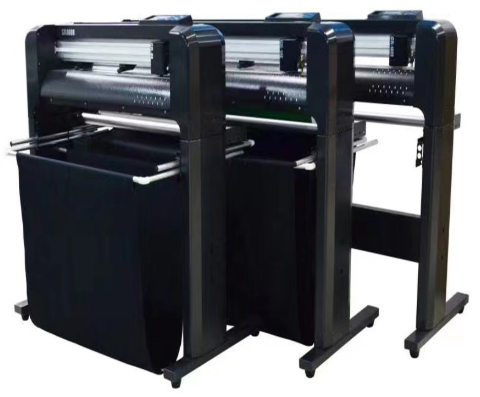
One of the first specifications to check is cutting width. VICUT offers the GR8000 series in three sizes: GR8000-80, GR8000-140, and GR8000-180. The listed maximum cutting width for non-contour cutting is 690 mm, 1290 mm, and 1630 mm respectively, while contour cutting widths are 600 mm, 1220 mm, and 1520 mm. The maximum mountable media width is 840 mm, 1440 mm, and 1780 mm.
For smaller shops, the 80 cm class is often the most practical because it fits compact production spaces and covers many common signage and decal tasks. For businesses that work with broader graphics or larger roll stock, the 140 cm or 180 cm versions provide more flexibility and help reduce the need to split jobs into multiple passes. In general, choosing a width that comfortably exceeds your most common material size is smarter than choosing the absolute minimum that barely fits today’s work. That is an inference from the model dimensions and intended applications.
Look at speed, force, and precision together
A cutting plotter should be evaluated as a complete system, not by one number alone. The GR8000 series lists a maximum cutting speed of 800 mm/s, a maximum cutting force of 600 gf in 8 steps, force adjustment in 1 gf increments, a servo drive, and a mechanical resolution of 0.0125 mm. It also lists minimum sizes such as 0.8 mm circle diameter, 1 x 1 mm characters, and 3 x 3 mm numbers, which is useful if your business deals with detailed text or small graphics.
Why does this matter? Speed helps with throughput, but without stable tracking and accurate force control, fast output can lead to waste. High precision is especially important for fine lettering, contour cutting, and specialty films. The GR8000 product page highlights grating ruler control, blade-tip compensation by hardware, and smooth edge quality, all of which are signs that the machine is designed to preserve quality while running quickly.
Don’t ignore tracking stability
For roll feeding machines, long-length tracking is one of the most important features to examine. If the material drifts, shifts, or feeds unevenly, even a powerful cutter will create poor results. VICUT says the GR8000 series uses accurate rigid push rollers, precise feeding rollers, and quality media bracket rollers to support stable long-length tracking. The product page also emphasizes stable tracking for extended rolls and describes the machine as suitable for big sign and pattern making.
This is especially valuable for businesses that run longer production jobs or process large graphics. A machine that keeps material steady reduces rework and helps preserve registration accuracy across the full length of the roll. In practice, that means fewer interrupted jobs, fewer miscuts, and more consistent results from the first meter to the last. This is an inference based on the product’s tracking features and use-case positioning.
Check the cutting system and control features
A strong cutting plotter should give you confidence when handling different materials. VICUT describes several features that support this, including a suction cutting table for keeping media flat, servo motor closed-loop control for overload protection, and a grating ruler that measures the distance between the blade tip and the material surface in real time, with depth adjusted by 0.01 mm increments. The page also says the machine uses hardware-based blade-tip compensation, which helps maintain precision regardless of CAD or CAM software.
These details matter because businesses rarely cut only one material. A plotter that can adapt to different thicknesses and surface conditions is more flexible and less likely to become outdated as your product range grows. If your shop plans to expand into reflective film, PPF, or layered materials, control quality should be high on your checklist. The product page also notes support for multiple layers and different cutting forces for different layers.
Make software and workflow part of the decision
A cutting plotter is only useful if it fits into your daily workflow. The GR8000 series lists Windows driver support, SignWork Pro, CAD to Plot Pro, HP-GL and PLT file formats, USB and RS-232 ports, and English/Chinese LCD support. It also mentions an optional media sensor and software-based support for multiple cutting paths and color sequencing. For businesses running recurring jobs, these workflow details can save time and reduce operator error.
If your team already uses a certain design or plotting process, it is wise to choose a machine that integrates cleanly instead of forcing a major software change. That is especially true for production shops with multiple operators, where consistency matters as much as raw performance. This is an inference based on the machine’s listed software and file-format compatibility.
Consider support, training, and after-sales service
For business buyers, support can be just as important as hardware. VICUT states that it provides technical support and solutions within 8 hours, remote and on-site training, user manuals, and operation videos. The product page also mentions CE, SGS, and BV certified cutting machines. If your business depends on uptime, this kind of support structure can be a major advantage, because it reduces the risk of long production delays when your team needs setup help or troubleshooting.
Which VICUT roll feeding cutting plotter is best for you?
If you are a small or mid-sized business focused on decals, labels, film cutting, and sign work, the GR8000-80 is a strong place to start because it combines compact width with professional-level precision and tracking. If your business handles wider graphics or larger roll formats, the GR8000-140 or GR8000-180 gives you more room to grow. The best choice is the one that matches your most common material width, your average order size, and the precision level your customers expect.
If your workflow requires full cutting, perforation or conveyor feeding rather than mainly roll-plotter work, compare the equipment categories in this guide.
Final takeaway
The best roll feeding cutting plotter is not simply the one with the longest spec sheet. It is the one that fits your material width, keeps long rolls stable, delivers the accuracy your products require, and supports your workflow without slowing your team down. VICUT’s GR8000 series stands out because it combines wide model options, high cutting speed, fine force adjustment, servo-driven control, and features designed for long-length tracking and high-precision film cutting. For businesses that want a reliable solution for signage, automotive film, labels, and similar roll-based applications, that combination makes the machine line worth serious consideration.
 vicutcnc@cncvicut.com