Key Takeaways
Choosing a roll label die cutting machine manufacturer should involve more than comparing machine prices and cutting speeds.
Label converters should verify whether the supplier can test real production materials, understand complete label finishing workflows, maintain consistent manufacturing quality, provide relevant conformity documentation, supply spare parts, and support overseas equipment after installation.
A reliable manufacturer should also offer several machine configurations rather than forcing every converter into one model.
The right supplier helps reduce commissioning risk, production downtime, and long-term operating problems—not simply the initial equipment cost.
Buying a digital label cutter is different from purchasing a simple office machine.For a label converter, the equipment may become part of a production workflow that runs every day and processes different face stocks, liners, adhesives, roll widths, artwork, and order quantities. If the machine is incorrectly specified—or if technical support disappears after delivery—the lower purchase price can quickly become irrelevant.That is why choosing a roll label die cutting machine manufacturer should begin with the supplier's ability to support your actual converting work.
Vicut's existing roll label product range, for example, includes different configurations for roll-to-roll, roll-to-sheet, digital cutting, slitting, lamination, matrix removal, and rewinding rather than relying on a single machine architecture.
1. Check Whether the Manufacturer Can Prove the Machine With Your Labels
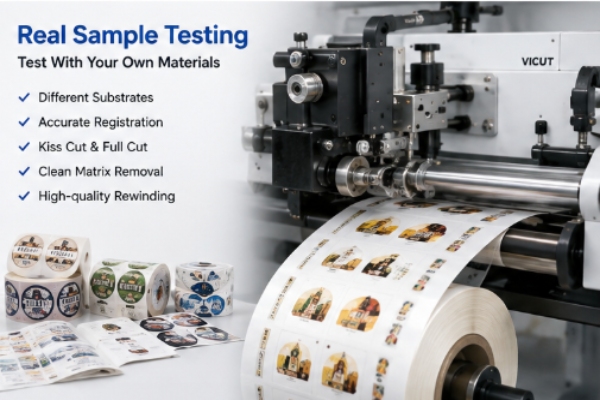
A professional label die cutting machine manufacturer should be willing to discuss actual jobs before recommending equipment.A standard demonstration using easy-to-cut paper stickers tells you relatively little if your factory mainly produces PET cosmetic labels, laminated BOPP labels, long-format labels, or difficult kiss-cut applications.The most useful evaluation is a sample test using your own production materials.
Send the supplier information such as:
printed roll material and liner;
roll width and diameter;
finished label dimensions;
kiss-cut or full-cut requirement;
typical artwork and registration marks;
expected order quantity.
Then evaluate the finished result rather than only watching the machine run.
A reliable roll label cutter manufacturer should be able to explain not only whether the material can be cut, but how cutting pressure, registration, feeding, waste removal, and rewinding should be configured. Use our digital label cutter test plan to turn a sample demonstration into measurable acceptance criteri
2. Look for Label Converting Knowledge, Not Just Cutting Knowledge
A cutter does not operate in isolation.A typical digital label finishing workflow can involve:Printing → Registration → Lamination → Kiss Cutting → Matrix Removal → Slitting → Rewinding
If a supplier only discusses cutting speed, it may not fully understand the production problems that occur before and after the cutting station.For example, inaccurate web feeding can create registration errors even when the cutting mechanism itself is precise. Poor tension control can affect rewinding. Weak matrix removal can slow the line after otherwise successful kiss cutting.This is why an experienced label converting equipment supplier should be able to discuss the whole process.
3. Does the Manufacturer Offer Enough Equipment Choices?
A manufacturer with only one machine may naturally recommend that machine to almost every customer.That is not always the same as recommending the right equipment.A stronger digital label cutter manufacturer normally offers different options for different production volumes, roll formats, automation requirements, and finishing workflows.
4. Ask How the Machines Are Built and Tested
Ask the roll label die cutting machine manufacturer how quality is controlled during production.For industrial equipment, useful evidence can include component inspection, assembly records, machine debugging, cutting accuracy testing, continuous running tests, and final sample verification.For a converter, the goal is to understand whether machine performance is checked systematically before shipment.
5. Verify Documentation for Your Destination Market
Certification logos should never be the only reason to approve a supplier.A serious label finishing machine manufacturer should be able to provide documentation that corresponds to the actual equipment model being purchased.For European buyers, machinery placed on the EU market is still subject to the current machinery safety framework in 2026.
Depending on the market and machine, buyers should verify relevant:
conformity documentation;
electrical specifications;
safety information;
operating manuals;
machine model and serial information;
supporting test or inspection documents.
6. After-Sales Support Can Be More Important Than a Small Price Difference
For an overseas label converter, equipment downtime is expensive.If a machine stops during a rush order, the important question is not whether it was several hundred dollars cheaper at purchase. The question is how quickly production can restart.
When evaluating a digital die cutting machine manufacturer, ask how technical support actually works after installation.Check whether the supplier provides remote diagnostics, training videos, operating manuals, software support, spare parts, firmware updates, and access to technicians who understand the equipment.
Roll Label Die Cutting Machine Manufacturer Evaluation Checklist
| What to Check | What a Converter Should Verify |
|---|
| Manufacturing capability | Own assembly, debugging and testing capability |
| Real sample testing | Ability to test your substrate and artwork |
| Product range | Multiple configurations for different job volumes |
| Workflow knowledge | Cutting, lamination, matrix removal, slitting, rewinding |
| Registration capability | Reliable handling of digitally printed rolls |
| Quality control | Documented testing before shipment |
| Compliance support | Documentation for the destination market |
| Spare parts | Availability and delivery process |
| Technical support | Remote troubleshooting and technician response |
| Warranty | Clear scope, period and exclusions |
| Export experience | Shipping, documentation and overseas communication |
Ask the supplier to report accepted output and total elapsed time using this reproducible throughput method.
7. Compare the Manufacturer on Total Production Risk
Price still matters, but it should not be the only comparison.A low-cost roll label cutter supplier can become expensive if the machine requires repeated adjustment, creates excessive waste, has limited spare-parts availability, or cannot receive timely technical support.Instead of comparing only quotations, consider the total risk surrounding the equipment:
Can it process your current materials? Can it handle future product changes? How difficult is commissioning? How quickly can problems be solved? Can replacement parts be supplied?
These questions are particularly important for converters using digital printing, where short runs and frequent SKU changes place different demands on finishing equipment than stable mass production.The best roll label die cutting machine manufacturer is therefore not necessarily the company offering the lowest machine price. It is the supplier that can demonstrate a practical fit between its equipment, technical team, and your production requirements.
Why Vicut Is Relevant to Label Converters
Vicut has worked in digital post-press cutting since 2013 and operates its own manufacturing base while serving international markets. Its roll label equipment is designed primarily around short- to medium-run digital finishing, with different models covering roll-to-roll and roll-to-sheet production. For label converters, the relevant advantage is not simply having several machines available.It is the ability to evaluate a production requirement across cutting, registration, lamination, matrix removal, slitting, and rewinding, then match that workflow with a suitable configuration.That is the type of discussion buyers should expect from any professional digital label finishing machine manufacturer.
FAQ
Q1:What is the best cutting machine for making die-cut stickers?
A digital roll label cutter is a strong choice for die-cut stickers because it supports contour cutting, short runs, and frequent design changes without custom dies.
Q2:What is the best die-cutting machine for beginners?
For beginners, an easy-to-use automatic digital cutter with simple software, reliable registration, and low setup requirements is usually the best option.
Q3:How do I choose a roll label die cutting machine manufacturer?
Choose a manufacturer that can test your real materials, demonstrate QC, provide compliance documents, and support the equipment after delivery.
 vicutcnc@cncvicut.com