Combining a roll cutter and a flatbed cutter can help a print or sign shop organize different cutting tasks around the equipment and material handling each job needs. The two machines can run separate jobs in parallel, or, where files, registration and media handling are compatible, process different stages of the same job. The gain is not automatic: compare accepted output after setup, transfers and inspection before deciding that two cutters are better than one.
● A roll-fed cutting plotter can handle suitable flexible-media contours while a flatbed works on other compatible jobs.
● A two-stage workflow may use the plotter for kiss cuts and the flatbed for a separate through-cut outline; both stages must be tested together.
● A roll-feeding flatbed is itself a flatbed machine: roll input does not make it the same thing as a roll-fed plotter.
● File formats, registration marks, sheet or roll transfer, and loose-piece control are critical handoff checks.
● Measure finished, accepted work over the whole job—not advertised cutting speed or the sum of two machine speeds.
What Does Each Cutter Contribute?
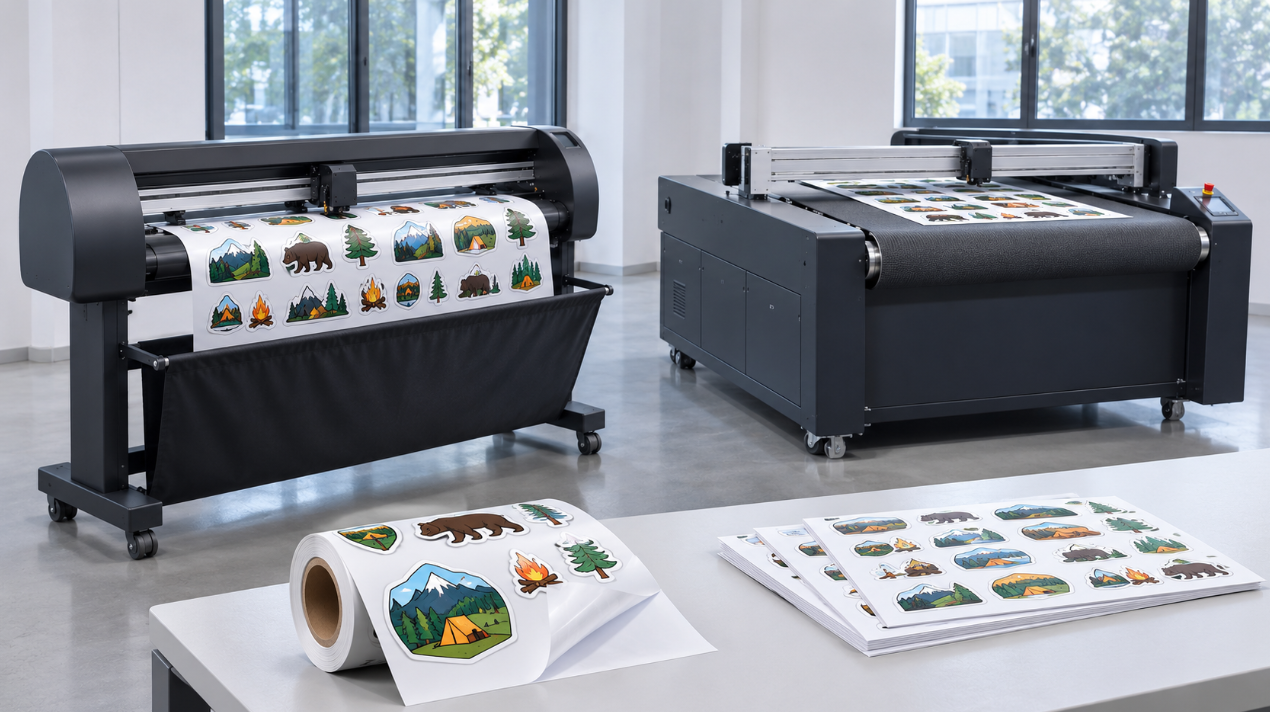
Here, roll cutter means a roll-fed vinyl or film cutting plotter, not a rotary die press or a roll label finishing line. The plotter feeds flexible media through the machine and follows a digital cutting path. A flatbed cutter supports material on a cutting surface; depending on its configuration, it may process placed sheets or advance flexible roll media over a conveyor.
VICUT offers both roll-fed cutting plotters and roll-feeding flatbed cutters. Their names describe different ways of handling media, not fixed guarantees about speed, accuracy or materials. Select the tools, working area and input method for the specific model and job.
For a machine-by-machine comparison, see flatbed vs roll cutter. The practical question here is different: how should a shop schedule and connect the two when both are available?
Two Ways to Use the Machines Together
| Approach | Example | What to check first |
|---|
| Parallel jobs | The plotter cuts vinyl lettering while the flatbed handles a separate printed sheet job. | Each job fits the machine, tools and available operator time. |
| Two stages of one job | The plotter kiss-cuts sticker contours; the flatbed later through-cuts the outer sheet shape. | Both stages can register the same print accurately and accept the material and job data. |
| One machine only | A configured flatbed completes both depths without a transfer. | A sample meets quality and delivery needs at a lower total handling burden. |
Parallel production does not require one machine to read the other machine’s file. The operator can prepare and schedule each job independently. A sequential job is more demanding because the partly finished material must remain controlled and aligned between machines.
A Practical Two-Stage Sticker Workflow
A shop producing printed sticker sheets can test the following route when the required output has kiss-cut designs inside a fully cut outer sheet:
● Prepare the artwork. Keep print artwork, internal kiss-cut contours and the outer through-cut boundary clearly identified. Plan registration marks that both stages can use.
● Print and prepare the media. Use the actual stock and, if required, laminate it according to the material supplier’s instructions. Allow room for marks, margins and handling.
● Kiss-cut on the plotter. Set the blade for the face material and adhesive while preserving the liner. Check peel quality and liner condition before processing the batch.
● Transfer the material. Rewind or separate into manageable sections only if the selected equipment and marks support that method. Label the job and keep registration marks visible and undamaged.
● Register and through-cut on the flatbed. Load the approved compatible roll or sheet, align the second-stage outer path and cut through the outer sheet boundary with the appropriate tool and support.
● Inspect and collect. Check print-to-cut alignment, peelability, liner integrity, complete outer separation and the handling of finished sheets and waste.
Kiss cutting and through cutting are defined by the layers cut, not by the machine name. The kiss cutting vs full cutting guide explains why liner condition and finished-piece handling matter at both stages.
This is a workflow to validate, not a claim that any two machines automatically share registration marks, files or software. If the marks cannot be read on both machines, if media cannot be transferred without movement, or if the second cut does not align, use another approved workflow instead.
Prevent Problems at the Handoff
Confirm files and registration. Ask whether each machine can import the intended cutting data and recognize the chosen registration marks. Check orientation, scaling and origin in both software environments. If separate exports are needed, verify that both are generated from the same approved artwork version. Test the first, middle and last sections, especially on long or laminated work.
Plan material transfer. The first stage must leave enough uncut carrier and margin for the next stage. Decide whether the flatbed receives a roll or pre-cut sections; a static flatbed should not be assumed to accept a roll. Protect marks from trimming, lamination glare, curl or damage, and avoid stretching or skewing the material during transfer.
Control pieces and waste. Full-cut pieces can shift or drop after separation. Confirm hold-down, cutting surface, collection and waste removal with the actual material. Do not run a full-cut layout through a feed path if loose pieces could interfere with transport. Tabs, alternate sequencing or another output format may be needed, subject to testing.
Where Can a Two-Cutter Setup Help?
A sign producer handling long vinyl graphics and separate short-run printed decals may use the plotter for compatible roll work while the flatbed processes suitable sheet or conveyor work. A mixed-depth sticker-sheet order may justify the sequential route when the plotter handles the internal contours and the flatbed can reliably cut the outer shape.
VICUT has shown a reflective-film cutting plotter alongside a conveyor flatbed in its traffic-sign exhibition overview. That page describes their respective applications; it does not establish automatic file sharing or a tested two-machine production line. Reflective films, laminates and backing constructions still need model-specific sample tests.
A second machine is not always the right answer. If one configured cutter already produces both required cut depths within the delivery window, extra loading, software preparation and handling may make a transfer slower or more expensive. Space, staffing, maintenance and utilization also matter.
How to Measure the Real Improvement
Compare the existing route and the proposed route using the same material, artwork, quantity, acceptance criteria and finished format. Record the time from job preparation to inspected, packed output, including printing or lamination only if they are part of both measured workflows.
Track setup and registration, active cutting, operator handling, transfer, waiting, inspection and rework separately. Then calculate accepted finished pieces divided by total elapsed production time for each route. Record operator labor time and material waste separately; do not add the headline speeds of the two machines. In a parallel test, compare the same set of orders over the same observation window and count each accepted piece once.
If the plotter finishes quickly but the flatbed queue grows, the constraint has moved rather than disappeared. Adjust the schedule or batch size, then repeat the test before making an equipment decision.
Frequently Asked Questions
Can a roll cutter and a flatbed cutter work on the same job?
Yes, if the material, cut paths, registration and transfer method are compatible. One possible arrangement is a kiss-cut pass followed by a through-cut pass. Confirm the actual models and software with a complete sample; compatibility should not be assumed.
Does every sticker job need both machines?
No. Some sticker sheets or decals can be completed on a single suitably configured machine. Compare the required cut depths and finished format with the time and quality of a two-stage route.
Is a roll-feeding flatbed cutter the same as a roll-fed cutting plotter?
No. A roll-feeding flatbed advances flexible media onto a flat cutting area, while a roll-fed plotter feeds media through its cutting mechanism. Both can work with rolls, but their tools, material support and available operations depend on the model.
What should I send for a production test?
Provide the material and liner construction, roll or sheet dimensions, printed and laminated condition, artwork and cut paths, finished output, batch size and quality requirements. State whether the job must run in parallel or pass between two machines.
Build the Workflow Around the Finished Job
A roll cutter and a flatbed cutter are most useful together when the work can be divided without creating a larger handoff problem. Start with the output your customer needs, check each machine’s role and run a timed sample through the complete process. Contact VICUT with your material and files to discuss suitable equipment and a model-specific test plan.
 vicutcnc@cncvicut.com