Key Takeaways
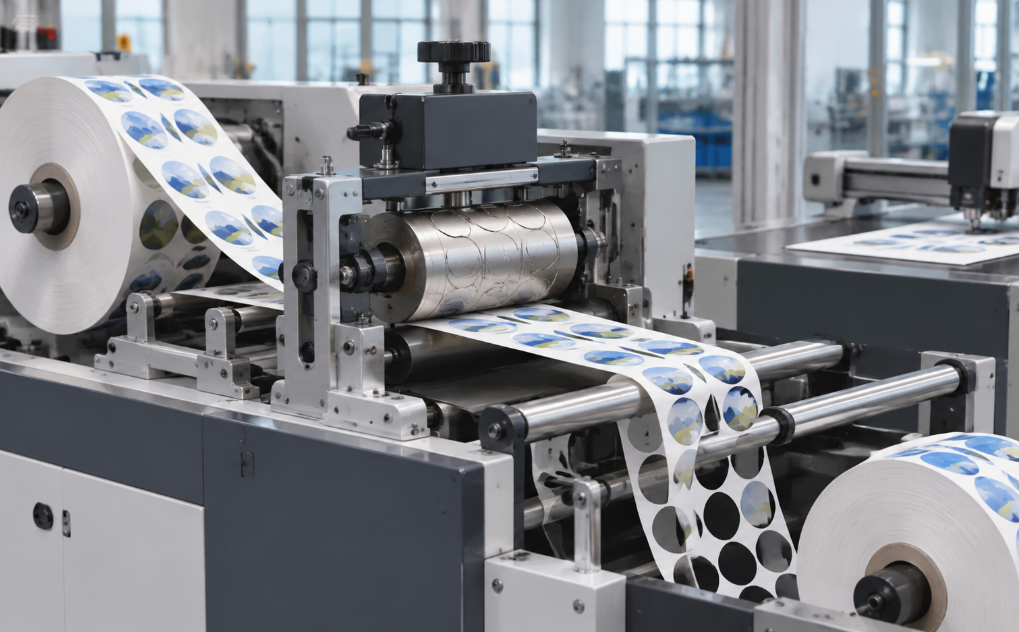
A rotary die cutting machine feeds material between a rotating cylindrical cutting tool and an anvil, producing the same repeat continuously.
In label converting, the die normally kiss-cuts the facestock and adhesive while preserving the release liner; the waste matrix is then removed.
Rotary die cutting suits stable, repeat production because the physical die cuts a complete pattern each revolution.
“Rotary” and “roll-fed” are not synonyms. A roll-fed digital cutter may use moving knives rather than a cylindrical die.
Before buying, confirm the actual cutting mechanism, tooling, web width, repeat, registration, finishing stations and finished roll specification.
A rotary die cutting machine is a continuous converting machine that uses a cylindrical die rotating against an anvil to cut a moving web or sheet. For labels, the web is typically unwound, guided, die-cut, stripped of waste, slit and rewound. The process is well suited to repeated shapes and stable production, but every new contour normally requires compatible physical tooling.
How Does Rotary Die Cutting Work?
The core cutting station has two working elements:
Rotary die or flexible die on a magnetic cylinder: carries the cutting pattern.
Anvil cylinder: supports the material and provides the counter-surface at the cutting nip.
The web passes between them while both rotate in synchronization. Cutting-edge height, pressure, cylinder condition and the exact label laminate determine whether the die passes through the facestock and adhesive without damaging the liner.
Typical Rotary Label Converting Sequence
unwind → web guide/tension control → registration → rotary die station → matrix removal → slitting → inspection/counting → rewind
Some lines add printing, varnish or lamination; others perform only selected steps. Buyers should request a station-by-station diagram because “rotary die cutter” does not guarantee a complete label finishing line.
Rotary Die, Semi-Rotary and Digital Cutting
| Method | Cutting action | Tooling logic | Best starting point |
|---|
| Full rotary die cutting | Die and web run continuously | Physical die matched to pattern/repeat | Stable high-volume repeat work |
| Semi-rotary die cutting | Web reciprocates while die works over repeats | Physical die; repeat flexibility depends on system | Varied repeats with conventional die quality |
| Digital blade cutting | One or more knives follow a file | No shape-specific physical die | Short runs, many SKUs and frequent changes |
| Digital laser cutting | Laser follows a file | No physical die; material/process limits apply | Variable work and complex paths where compatible |
Full rotary systems gain production strength from cutting a complete repeat on every revolution. Semi-rotary systems change web motion to use tooling across different repeats. Digital systems trace contours and exchange physical die preparation for file setup and cutting-path time.
Is Every Roll Label Cutter a Rotary Die Cutter?
No. A machine can be roll-fed without using a rotary die. Digital roll label cutters may unwind and rewind material but cut on a vacuum table or with moving blade heads. Some supplier pages use “rotary die cutting machine” as a broad market term even when the specification also says “no cutting dies required.”
Resolve that contradiction before comparing equipment. Ask the supplier to state:
whether the cutting pattern is a solid/flexible cylindrical die or a digital file;
whether the web moves continuously, intermittently or onto a cutting table;
how many blade heads or die stations are included;
whether a new shape requires new metal tooling;
which station performs matrix removal, slitting and rewinding.
VICUT’s roll label die cutting machine category primarily presents digital, dieless roll finishing systems. Individual model pages must be read by mechanism and configuration, not by product-name wording alone.
What Materials and Label Jobs Fit Rotary Die Cutting?
Rotary die cutting is widely used for pressure-sensitive papers and films, but broad material names do not confirm suitability. The die must be designed for the facestock, adhesive and liner combination, and the line must control tension and matrix removal. Labels with stable contours and repeat orders are natural candidates because tooling can be reused.
Common label outputs include product labels, logistics labels, blank labels and printed pressure-sensitive labels. The same general technology also serves other converted components, but a label machine should not be assumed to process foams, metals or medical parts merely because industrial rotary die cutting exists in those sectors.
What Determines Cut Quality?
| Control point | What can go wrong |
|---|
| Die/anvil condition | Uneven or incomplete cut, liner damage |
| Impression/pressure | Adhesive bridges or crushed liner |
| Web tension and guide | Registration drift, wrinkles or matrix breaks |
| Material construction | Different release, thickness and cut behavior |
| Matrix design | Waste breaks or lifts finished labels |
| Slitting/rewind | Poor edges, telescoping or wrong finished roll |
Approve the complete finished roll. Peel labels across every lane and repeat, inspect the liner, watch matrix stripping, then check slit edges and rewind quality. Repeat the test after the line reaches normal operating condition.
When Should You Choose Rotary or Digital Label Cutting?
Choose conventional rotary die cutting first when one approved design repeats at sustained volume and tooling/changeover can be amortized. Choose digital cutting first when order quantities are short, contours change often, many SKUs share the same material or customers request samples before committing.
Do not use a generic run-length threshold. Compare tooling lead time and storage, setup waste, cutting time, changeovers, material, operator skill and future reorders. The related guide to digital versus traditional die cutting provides a practical break-even worksheet.
How VICUT Fits This Decision
VICUT supplies digital post-press cutting and roll label finishing equipment for short- to medium-run workflows. If your priority is dieless changeover, review the VICUT digital roll label cutter range. If your operation requires a physical rotary die press, state that requirement explicitly so the technologies are not compared under the same label.
Send the actual artwork, material construction, roll width and diameter, run profile, finishing operations and finished roll or sheet specification. A controlled test will show whether a proposed digital configuration fits the job.
Rotary Die Cutter Buying Checklist
Before comparing quotations, ask the supplier to state the exact die-cutting architecture, compatible web width and core, die and anvil scope, material construction tested, registration method, web-tension controls, matrix-removal path, slitting and rewinding options, included training and sample-test result. Do not treat optional modules as included production capability.
Prepare the same printed roll and acceptance criteria for every supplier. Inspect the first, middle and final sections of the roll for liner strikes, lifted labels, matrix breaks, uneven slit edges and winding problems. If the converter runs more than one material construction, repeat the test rather than using one stock as a proxy for all others.
Frequently Asked Questions
What is the difference between a rotary die cutter and a digital die cutter?
A rotary die cutter uses shaped physical tooling rotating against an anvil. A digital cutter follows a cut file with a blade or laser and does not need a shape-specific die.
Can rotary die cutting kiss-cut labels?
Yes. Label tooling can cut the facestock and adhesive while preserving the liner, provided the die, impression and laminate are correctly matched.
What is the role of matrix removal?
Matrix removal strips the waste material surrounding the finished labels while labels remain on the liner.
Is rotary die cutting always faster?
It is often strong for stable repeated production, but total job time includes tooling, mounting, setup, waste and changeover. Compare the complete order, not cutting motion alone.
Compare Rotary and Digital Routes With VICUT
If your order mix includes both stable repeat work and frequently changing short runs, prepare two or three representative jobs before choosing a process. Share the run lengths, repeat frequency, material construction, contour complexity and finished-roll requirements with VICUT. Contact VICUT to evaluate whether a dieless digital roll label cutting system should be tested for all or part of that workload.
 vicutcnc@cncvicut.com